By Ted Anthony and Mary Foster, Associated Press Writers.
There is still a hole in the Earth, crude oil is still spewing from it and there is still, excruciatingly, no end in sight. After trying and trying again, one of the world’s largest corporations, backed and pushed by the world’s most powerful government, can’t stop the runaway gusher.
As desperation grows and ecological misery spreads, the operative word on the ground now is, incredibly, August is the earliest moment that a real resolution could be at hand. And even then, there’s no guarantee of success. For the United States and the people of its beleaguered Gulf Coast, a dispiriting summer of oil and anger lies dead ahead.
Oh … and the Atlantic hurricane season begins Tuesday.
The latest attempt — using a remote robotic arm to stuff golf balls and assorted debris into the gash in the seafloor — didn’t work. On Sunday, as churches echoed with prayers for a solution, BP PLC said it would focus on containment rather than plugging the undersea puncture wound, effectively redirecting the mess it made rather than stopping it.
“We failed to wrestle this beast to the ground,” said BP Managing Director Bob Dudley, doing the rounds of the Sunday talk shows.
Trouble is, the longer it lasts, the more beasts emerge ready to wrestle. Crude-coated birds are becoming a frequent sight along coastal areas. At the sea’s bottom, no one knows what the oil will do to species like the newly discovered bottom-dwelling pancake batfish — and others that remain unknown but just as threatened.
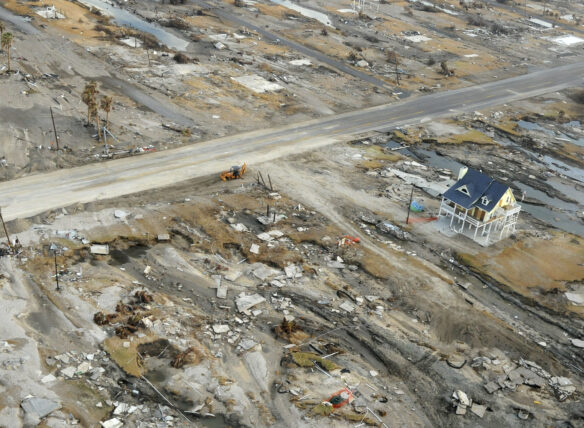
Perhaps most alarming of all, 40 days and 40 nights after the Deepwater Horizon blew up and began the underwater deluge, hurricane season is at hand. It brings the horrifying possibility of wind-whipped, oil-soaked waves and water spinning ashore and coating areas much further inland. Imagine Katrina plus oil spill.
On its own, the spill is already the worst in American history — worse, even, than the 1989 Exxon Valdez disaster. It has released between 18 million and 40 million gallons of oil into the Gulf, according to government estimates that are, like all numbers involved in this brouhaha, subject to vigorous debate.
The trepidation is less disputed. “This is probably the biggest environmental disaster we’ve ever faced in this country,” White House Energy and Climate Change Advisor Carol Browner said on NBC’s “Meet the Press.”
At some point, the widespread debut of the BP “spillcam” is as good a delineation point as any, this tipped, in the national conversation, from a destructive event into a calamitous, open-ended saga. And for the bruised and cantankerous American psyche, it could not come at a worse time.
Fear is afoot everywhere, and polarization prevails. Faith in institutions, corporations, government, the media, is down. Americans are angry, and they long ago grew accustomed to expecting the resolution of problems in very short order, even if reality rarely works that way.
So when something undefined and uncontrollable happens, they speculate in all the modern forums about collusion and nefarious dealings. In the process, this tale of environmental disaster and economic damage cripples the sea-to-shining-sea narrative that usually offers Americans comfort during uncertain times.
“There are people who are getting desperate, and there are more getting anxious as we get further into the shrimping season and there is less chance they will recover,” said the Rev. Theodore Turner, 57, at Mount Oliver Baptist Church in Boothville, near where oil first washed ashore. Fishermen make up about a third of his congregation.
With the “junk shot” and the “top kill” behind it, BP’s next effort involves an assortment of undersea robot maneuvers that would redirect the oil up and out of the water it is poisoning. The decision effectively means that the notion of stopping the crude entirely is receding into the background for now.
The first step in BP’s latest effort is the intricate removal of a damaged riser that brought oil to the surface of the Deepwater Horizon rig. The riser will be cut at the top of the crippled blowout preventer, creating a flat surface that a new containment valve can seal against.
The valve would force the oil into a new riser, bringing it up to a ship. The seal, however, would not prevent all oil from escaping. How much could still leak remains a subject of debate.
If the containment valve fails, there are other options. Next on BP’s list: installing a new blowout preventer on top of the existing one.
In the end, however, the only permanent solution is the drilling a relief well that would relieve the pressure on the runaway gusher in favor of a controlled pumping — essentially what the Deepwater Horizon was trying to do in the first place. But that will take at least two months.
That’s not just two months of dealing with the extensive damage done until now to oceans, beaches and marshlands. It’s two months more of oil pouring outward and upward — and two months more toward the heart of hurricane season and its potential to sow destruction.
Using government figures, if the leak continues at its current pace and is stopped on Aug. 1, 51 million to 106 million gallons will have spilled. If it stops Aug. 15, 58 million to 121 million gallons will have spilled. If it is not stopped until the end of August, that figure rises to 65.5 million gallons to 136.5 million gallons. That’s quite a range of possibilities.
“They are going to destroy south Louisiana. We are dying a slow death here,” said Billy Nungesser, president of Plaquemines Parish, La.
Coastal tent cities are about to rise to house the workers and contractors charged with fixing and minimizing the damage. Sand banks and barriers are being built. But the consensus around the Gulf Coast is turning more apoplectic and apocalyptic. This is, people are starting to say, a generational event — tragic to this generation, potentially crippling to the next.
“The oil spill is part of prophecy,” said Turner, the Louisiana minister. “The Bible prophesized hardships. If we believe the word of God is true — and we do — we also know that in addition to prophecying hardships he promised to take care of us.”
As BP and the government chart the way forward, there remain prominently unanswered questions along the way.
How involved has the Obama administration been, how involved should it have been, and how much control should BP be given for events that are of public interest and happening in public places? Why have BP, scientists and the government been unable to accurately capture how much is actually leaking, the extent of damage and figure out how to fix it? And what can be done now to prevent even more of a disaster from unfolding, and to ensure transparency as decisive steps are taken to fix what’s broken?
“I am resolute and confident that we will see a better day ahead of us,” Interior Secretary Ken Salazar said Saturday. And yet that statement, stacked up against the word “August,” tempers the optimism for many watching this saga unfold.
They see a dissembling corporation, an ineffective government and an ocean surface covered by a viscous shell with the consistency of molasses and the peril of poison. To them, it comes down to only this: There is still a hole in the Earth. Crude oil is still spewing from it. And there is still, excruciatingly, no end in sight.