By Elisabeth Rosenthal, The New York Times.
“If we’ve learned anything so far about the deepwater Gulf of Mexico, it is that it contains surprises. And that means an operator needs depth, depth in terms of resources and expertise, to create the capability to respond to the unexpected. ”
These prophetic words came from a 2005 presentation by David Eyton, who was then vice president for BP’s deepwater developments in the Gulf of Mexico. Reprinted that year in a journal of the Society of Exploration Geophysicists, the speech acknowledged that oil companies “did somewhat underestimate the full nature of the challenges we were taking on in the deep waters of the gulf.”
Still, Mr. Eyton expressed buoyant optimism that BP’s risk management expertise, as well as its new technologies, would play a “critical role” in allowing the company to triumph over nature’s daunting obstacles.
As the world now knows, it did not turn out that way.
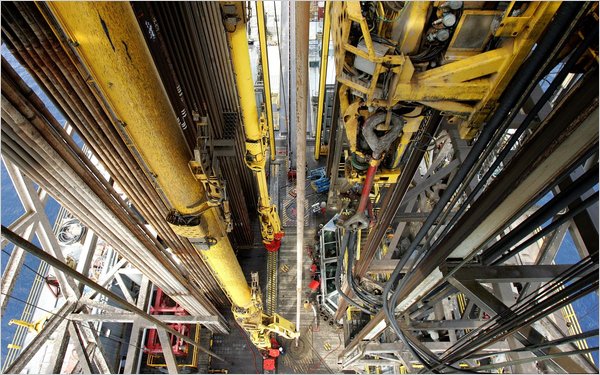
As BP struggled last week to stanch the flow of spewing oil at the Deepwater Horizon rig, it has become clear that the pressure to dig deeper and faster from what Mr. Eyton then called a “frontier province” of oil exploration has in some ways outpaced the knowledge about how to do that safely. (And there is still the question of whether BP used all the tools and safety mechanisms available.)
Americans have long had an unswerving belief that technology will save us — it is the cavalry coming over the hill, just as we are about to lose the battle. And yet, as Americans watched scientists struggle to plug the undersea well over the past month, it became apparent that our great belief in technology was perhaps misplaced.
“Americans have a lot of faith that over the long run technology will solve everything, a sense that somehow we’re going to find a way to fix it,” said Andrew Kohut, president of the Pew Research Center for the People and the Press. He said Pew polling in 1999, before the September 2001 terror attacks, found that 64 percent of Americans pessimistically believed that a terrorist attack on the United States probably or definitely would happen. But they were naïvely optimistic about the fruits of technology: 81 percent said there would be a cure for cancer, 76 percent said we would put men on Mars.
Our experience of technology has been largely wondrous and positive: The green revolution ameliorated the problem of world hunger (for a time at least) with better seeds and fertilizers to increase harvests. When childhood diseases were ravaging the world, vaccines came along and (nearly) eliminated them. There are medicines for the human immunodeficiency virus and AIDS. There is the iPad.
Many experts in the field of undersea oil exploration believe that technology can also resolve the risks of operating tens of thousands of feet under the seabed, despite BP’s current problems.
“We’re pushing the envelope, but I personally believe that the technology, in terms of equipment and processes, will be able to keep up with what we’re doing, though this experience may slow things down,” said Stefan Mrozewski, a senior staff associate at the Lamont-Doherty Earth Observatory of Columbia University, whose research involves projects like drilling boreholes in deep water to study chemicals under the seafloor.
He previously worked as an engineer in the oil industry on deepwater rigs in the Gulf of Mexico.
He said the blowout on the rig and the apparent failure of the blowout preventer was “beyond the realm of expectation,” most likely a combination of unimaginable human and mechanical error. Noting that rigorous planning precedes deepwater drilling, yet “the risk is still not zero,” he said the accident last month would encourage designers and engineers to improve the technology and procedures, so that a disaster like the Deepwater Horizon explosion could not happen again.
Still, as he watched a live feed of drilling mud being pumped into the leaking well on the seabed, he acknowledged that the science of repair and cleanup seemed lacking. “My impression is that we were unprepared for this,” he said. “There were not a lot of good technologies and techniques ready.”
William Jackson, deputy director general of the International Union for Conservation of Nature in Gland, Switzerland, said abstract devotion was misguided: “At this time in history we have great faith in having the technological ability to solve problems, and that faith has proved incorrect in this place.”
He said that even good new ideas needed funding and testing to make sure they worked. He pointed out that pledges by the coal industry and some countries to curb future carbon dioxide emissions often assume the successful evolution of technologies that are as yet unproven or have never been tried on a large scale.
“There is this belief that an engineering solution can be found as you move along,” he said, noting that carbon capture and storage, which involves pumping CO2 emissions underground rather than releasing them to the air, may be “there” as a science, but the costs prevent it from being a practical answer.
By all accounts, the oil industry is infused with this “can do” attitude: Oil running low? “Oil wells will run dry, but advances in technologies can put off the inevitable,” said a 2006 article in a newsletter of the American Oil and Gas Historical Society. In his 2005 talk, Mr. Eyton, now BP’s group head of research and technology, was not so cavalier, discussing the need for vigilant risk management.
“We find ourselves designing floating systems for 10,000 feet of water depth before the lessons of working in 6,000 feet have been fully identified,” he said.
He sang the benefits of technology while acknowledging its danger, expressing hope that fail-safe features and computer modeling could decrease the risk: “We know the premium associated with hardware reliability is high, but at this stage, operators still have a limited failure database for forecasting the required levels of intervention in ever-deeper and more remote environments.”
Technology, he added, “becomes both an enabler, while at the same time being itself a source of risk.”
In the beginning of May, a few weeks after the rig explosion, the Pew Research Center asked 994 Americans about the oil spill: 55 percent saw it as a major environmental disaster, and 37 percent as a serious problem. But at that time, at least, 51 percent also believed that efforts to prevent the spill from spreading would be successful. Hundreds of thousands of barrels of oil later, federal officials last week released a new estimate of the spill, 12,000 to 19,000 barrels a day, establishing it as the largest in American history. As Richard Feynman, the physicist, once observed, “For a successful technology, reality must take precedence over public relations, for nature cannot be fooled.” Sometimes ingenuity may not help us.
Indeed, think of all the planes grounded for nearly a week in northern Europe last month, as a volcano poured ash in the atmosphere. There was no technological fix, and many passengers couldn’t believe it. Said Mr. Kohut, of Pew Research, “The reaction was: ‘Fix this. Fix this. This is outrageous.’ ”