Once again, BP experiment in Gulf spill hits snag

Posted In Gulf Oil Catastrophe
Jun
3

By Melissa Nelson and Adam Geller, Associated Press Writers.

BP fumbled its latest underwater experiment with the wild Gulf gusher, just like every other endeavor the company has tried to fix the nation’s worst oil spill and BP’s chief executive said the company wasn’t fully prepared for the disaster.

First, a 100-ton, four-story box couldn’t contain the spill because icelike crystals clogged the top. Then, a straw-like device that actually did capture crude was inconsistent at best. The supposed top kill, shooting heavy mud and junk into the well, couldn’t overcome the pressure of the oil. And the most recent risky gambit ran into trouble a mile under the sea Wednesday when a diamond-tipped saw became stuck after slicing through about half of the blown-out well.

It took BP 12 hours to free the saw, and the company hopes to use giant shears similar to an oversized garden tool to snip off the pipe. However, the cut won’t be as clean if successful, and a looser fitting cap will have to be placed over the spill.
No timetable was given for when that might start, a familiar refrain in this six-week-old disaster.

The Financial Times on Thursday quoted BP CEO Tony Hayward as saying it was “entirely fair” to criticize the company’s preparations.

The newspaper quotes Hayward as saying: “What is undoubtedly true is that we did not have the tools you would want in your tool kit.”

However, Hayward said BP had been successful so far in keeping most of the oil away from the southeastern U.S. coast.
“Considering how big this has been, very little has got away from us,” Hayward was quoted as saying.

So far, each novel attempt to stop more oil from spewing into the Gulf has dragged on and misfired. All along, the company has been drilling a relief well, the best option at stopping the gusher, but it’s still two months away.

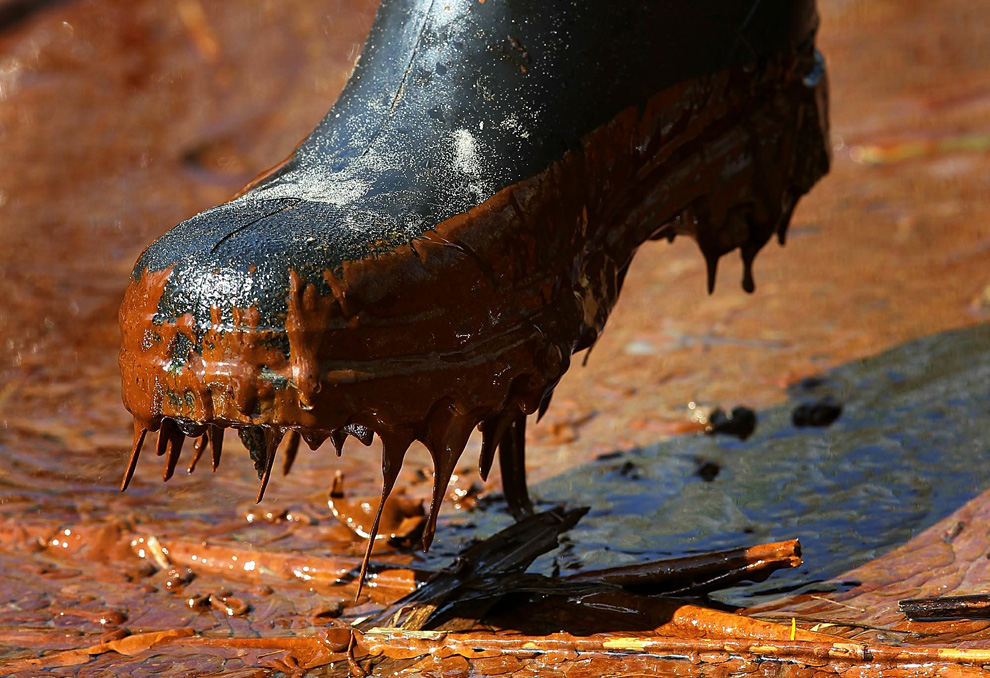
Since the biggest oil spill in U.S. history began to unfold April 20 with an explosion that killed 11 workers aboard an offshore drilling rig, crude has fouled some 125 miles of Louisiana coastline and washed up in Alabama and Mississippi. The well has leaked anywhere from 21 million to 45 million gallons by the government’s estimate.

The latest attempt to stop it, the so-called cut-and-cap method, is considered risky because slicing away a section of the 20-inch-wide riser could remove kinks in the pipe and temporarily increase the flow of oil by as much as 20 percent.
And the situation on the water’s surface becomes more dire with each day.

Oil drifted perilously close to the Florida Panhandle’s famous sugar-white beaches, and crews on the mainland were doing everything possible to limit the catastrophe. Coast Guard Adm. Thad Allen, the nation’s point man for the spill, directed BP to pay for five additional sand barrier projects in Louisiana. Boats were also sent packing east, along with four helicopters to help skimmers spot oil threatening Alabama, Mississippi and the Florida coast.

As the edge of the slick drifted within seven miles of Pensacola’s beaches, emergency workers rushed to link the last in a miles-long chain of booms designed to fend off the oil. They were slowed by thunderstorms and wind before the weather cleared in the afternoon.

Forecasters said the oil would probably wash up by Friday, threatening a delicate network of islands, bays and white-sand beaches that are a haven for wildlife and a major tourist destination dubbed the Redneck Riviera.

“We are doing what we can do, but we cannot change what has happened,” said John Dosh, emergency director for Escambia County, which includes Pensacola.

The effect on wildlife has grown, too.

The U.S. Fish and Wildlife Service reported 522 dead birds, at least 38 of them oiled, along the Gulf coast states, and more than 80 oiled birds have been rescued. It’s not clear exactly how many of the deaths can be attributed to the spill.
Dead birds and animals found during spills are kept as evidence in locked freezers until investigations and damage assessments are complete, according to Teri Frady, a spokeswoman for the National Oceanographic and Atmospheric Administration.

“This includes strict chain-of-custody procedures and long-term locked storage until the investigative and damage assessment phases of the spill are complete,” she wrote in an e-mail.

As the oil drifted closer to Florida, beachgoers in Pensacola waded into the gentle waves, cast fishing lines and sunbathed, even as a two-man crew took water samples. One of the men said they were hired by BP to collect samples to be analyzed for tar and other pollutants.

A few feet away, Martha Feinstein, 65, of Milton, Fla., pondered the fate of the beach she has been visiting for years. “You sit on the edge of your seat and you wonder where it’s going,” she said. “It’s the saddest thing.”

Officials said the slick sighted offshore consisted in part of “tar mats” about 500 feet by 2,000 feet in size.

County officials set up the booms to block oil from reaching inland waterways but planned to leave beaches unprotected because they are too difficult to defend against the action of the waves and because they are easier to clean up.
“It’s inevitable that we will see it on the beaches,” said Keith Wilkins, deputy chief of neighborhood and community services for Escambia County.

Florida’s beaches play a crucial role in the state’s tourism industry. At least 60 percent of vacation spending in the state during 2008 was in beachfront cities. Worried that reports of oil would scare tourists away, state officials are promoting interactive Web maps and Twitter feeds to show travelers, particularly those from overseas, how large the state is and how distant their destinations may be from the spill.

Original Article

Related Posts

Tags: ,

Post comment

Resources

Federal

  • Deep Water Horizon Response is the official site of the incident in conjunction with BP, DOI, NPS, USGS, CDC, USFWS, NOAA and other branches of the US government (collectively called Unified Command). Information, including the latest news, photos, area plans, and volunteer information.
  • NOAA is a government program that uses science and research to protect life, property and natural resources. This NOAA site provides maps of the spill and related statistics, including a trajectory forecast map for the oil spill.
  • The Environmental Protection Agency provides data on Air, Land, and Water pollutants including sampling maps and contaminant levels.

Louisiana

  • Volunteer Louisiana is the official site for the State of Louisiana to get involved in the spill response.
  • The Louisiana Department of Wildlife and Fisheries provides maps of closures to fishing areas in LA.
  • The Louisiana Emergency Office has made Google Earth files of the spill available to the public here http://gohsep.la.gov/oilspill.aspx and also has current information on general closures of waterways, photos, and reports.
  • The Audubon Nature Institute site provides a number for citizens to call if turtles, manatees, dolphins, or other animals are in distress
  • The Oiled Wildlife Care Network is a CA based non-profit is advising folks in the Gulf of Mexico on best practices and provide resources on how people can help.
  • The Coalition to Restore Coastal Louisiana is a non-profit organization who strive to protect and restore coastal Louisiana. Volunteers are needed for numerous actions including: monitoring, oiled wildlife recovery, boat driving, or simple monetary donations.
  • The Greater New Orleans Foundation is a philanthropic organization in Louisiana and the surrounding region that joins with other non-profit, foundations and community and government officials to address the needs of the community. The Foundation has opened the Gulf Coast Oil Spill Fund.
  • The Louisiana Bucket Brigade is an environmental health and justice organization working with communities near oil refineries and chemical plants. They aid residents in these regions to reduce pollution and protect public health. The Brigade has formed an incident map where you can report observed signs of oil.

Alabama

  • The Alabama Coastal Foundation is an education based organization whose mission is to project the quality of Alabama’s coastal resources. They are currently training volunteers to help directly with the spill response.
  • The site by the Alabama Governor’s Office of Faith-Based and Community Initiatives gives basic phone numbers.
  • The Mobile Bay National Estuary Program is an organization funded by the EPA fighting the environmental challenged facing Mobile Bay. This site gives e-mail addresses and phone numbers to help and provides basic information.
  • The Mobile Bay Keeper is a group of citizens who are interested in preserving the Mobile Bay watershed as well as protecting the health of the individuals and environment in the Bay. Check out the latest information about the spill and learn how to become a member and donate to the cause.

Mississippi

Florida

  • The Florida Department of Environmental Protection is the lead agency in FL and this website provides the most thorough information in the state.
  • Volunteer Florida, the website of the Governor’s Commission on Volunteerism and Community Service and the State Emergency Response Team, lists volunteer opportunities by county.
  • The Escambia County site provides summary points of actions taken by BP and FL with a focus on the County.
  • The Pinellas County site is a concise list of related local websites and numbers for information.
  • The Gulf County site has current news on the spill as it relates to the county
  • Volunteer directly with the largest wild bird hospital in the United States, the Suncoast Seabird Sanctuary.

Organizations and other networks

  • American Birding Association
  • Audubon is a global leader in protecting birds and other wildlife and their habitats. They are partnering with other organizations.
  • The Sierra Club is a grassroots environmental organization that works to protect communities, wild places, and the planet. Updates on the oil spill, as well as volunteer and donation information.
  • The Nature Conservancy is a conservation organization with a mission to preserve and protect ecologically significant lands and waters for nature and people. Learn more about the oil spill and how to help out at http://www.nature.org/wherewework/northamerica/states/alabama/features/oilspill.html and check out their blog.
  • Sea Grant is nationwide network (administered through NOAA) of 32 university-based programs that work with coastal communities on environmental stewardship and the responsible use of our coasts. The Gulf of Mexico Sea Grant Programs provides resources to educators with research that may be impacted by the spill.
  • The National Wildlife Federation is America’s largest conservation organization whose mission is to protect and restore wildlife habitat, confront global warming and connect with nature. Get the latest information on the oil spill crisis and how to help.
  • The mission of Tri-State Bird Rescue and Research is to provide rehabilitation of injured, orphaned, and oiled native wild birds to return to their natural environment. Donate to their research.
  • Green Peace is an international organization that strives to save the planet from environmental threats such as global warming, destruction of forests and deterioration of the oceans. Follow their blog and learn how to take action.
  • Global Green USA is an international environmental non-profit organization with an office in New Orleans that strives to fight global climate change, eliminate weapons of mass destruction and create clean, safe drinking water for all. Follow their blog and get involved.
  • Matter of Trust is a non-profit organization focused on materializing sustainable systems by mimicking Mother Nature as well as concentrating on manmade surplus, natural surplus and eco-educational programs. Learn very simple ways to help the oil spill crisis.
  • The official Facebook page of Unified Command.
  • BP Gulf of Mexico response.