On the Surface, Gulf Oil Spill Is Vanishing Fast; Concerns Stay

Posted In Gulf Oil Catastrophe, News
Jul
28

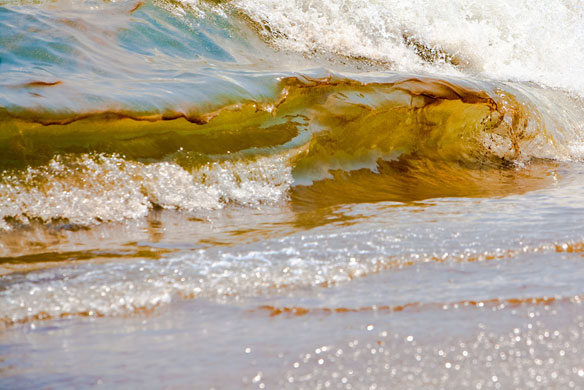
Oil on Beach

By Justin Gillis and Campbell Robertson, The New York Times.

The oil slick in the Gulf of Mexico appears to be dissolving far more rapidly than anyone expected, a piece of good news that raises tricky new questions about how fast the government should scale back its response to the Deepwater Horizon disaster.

The immense patches of surface oil that covered thousands of square miles of the gulf after the April 20 oil rig explosion are largely gone, though sightings of tar balls and emulsified oil continue here and there.

Reporters flying over the area Sunday spotted only a few patches of sheen and an occasional streak of thicker oil, and radar images taken since then suggest that these few remaining patches are quickly breaking down in the warm surface waters of the gulf.

John Amos, president of SkyTruth, an environmental advocacy group that sharply criticized the early, low estimates of the size of the BP leak, noted that no oil had gushed from the well for nearly two weeks.

“Oil has a finite life span at the surface,” Mr. Amos said Tuesday, after examining fresh radar images of the slick. “At this point, that oil slick is really starting to dissipate pretty rapidly.”

The dissolution of the slick should reduce the risk of oil killing more animals or hitting shorelines. But it does not end the many problems and scientific uncertainties associated with the spill, and federal leaders emphasized this week that they had no intention of walking away from those problems any time soon.

The effect on sea life of the large amounts of oil that dissolved below the surface is still a mystery. Two preliminary government reports on that issue have found concentrations of toxic compounds in the deep sea to be low, but the reports left many questions, especially regarding an apparent decline in oxygen levels in the water.

And understanding the effects of the spill on the shorelines that were hit, including Louisiana’s coastal marshes, is expected to occupy scientists for years. Fishermen along the coast are deeply skeptical of any declarations of success, expressing concern about the long-term effects of the chemical dispersants used to combat the spill and of the submerged oil, particularly on shrimp and crab larvae that are the foundation of future fishing seasons.

After 86 days of oil gushing into the gulf, the leak was finally stopped on July 15, when BP managed to install a tight-fitting cap on the well a mile below the ocean surface, then gradually closed a series of valves. Still, the well has not been permanently sealed. Until that step is completed in several weeks, the risk remains that the leak will resume.

Scientists said the rapid dissipation of the surface oil was probably due to a combination of factors. The gulf has an immense natural capacity to break down oil, which leaks into it at a steady rate from thousands of natural seeps. Though none of the seeps is anywhere near the size of the Deepwater Horizon leak, they do mean that the gulf is swarming with bacteria that can eat oil.

The winds from two storms that blew through the gulf in recent weeks, including a storm over the weekend that disintegrated before making landfall, also appear to have contributed to a rapid dispersion of the oil. Then there was the response mounted by BP and the government, the largest in history, involving more than 4,000 boats attacking the oil with skimming equipment, controlled surface burns and other tactics.

Some of the compounds in the oil evaporate, reducing their impact on the environment. Jeffrey W. Short, a former government scientist who studied oil spills and now works for the environmental advocacy group Oceana, said that as much as 40 percent of the oil in the gulf might have simply evaporated once it reached the surface.

An unknown percentage of the oil would have been eaten by bacteria, essentially rendering the compounds harmless and incorporating them into the food chain. But other components of the oil have most likely turned into floating tar balls that could continue to gum up beaches and marshes, and may represent a continuing threat to some sea life. A three-mile by four-mile band of tar balls was discovered off the Louisiana coast on Tuesday.

“Less oil on the surface does not mean that there isn’t oil beneath the surface, however, or that our beaches and marshes are not still at risk,” Jane Lubchenco, administrator of the National Oceanic and Atmospheric Administration, said in a briefing on Tuesday. “We are extremely concerned about the short-term and long-term impacts to the gulf ecosystem.”

Thad W. Allen, the retired Coast Guard admiral who leads the government’s response, has emphasized that boats are still skimming some oil at the surface. Admiral Allen said the risk of shoreline oiling might continue for at least several more weeks.

“While we would all like to see the area come back as quickly as it can,” he said, “I think we all need to understand that we, at least in the history of this country, we’ve never put this much oil into the water. And we need to take this very seriously.”

Still, it is becoming clear that the Obama administration, in conjunction with BP, will soon have to make decisions about how quickly to begin scaling down the large-scale, and expensive, response effort. That is a touchy issue, and not just for environmental reasons.

The response itself has become the principal livelihood for thousands of fishermen and other workers whose lives were upended by the oil spill. More than 1,400 fishing boats and other vessels have been hired to help deploy coastal barriers and perform other cleanup tasks. Those fishermen are unconvinced that the gradual disappearance of oil on the surface means they will be able to return to work soon.

“Surface is one thing; you know that’s going to dissipate and all,” said Mickey Johnson, who owns a shrimp boat in Bayou La Batre, Ala., pointing out that shrimpers trawl near the sea floor.

“Our whole big concern has always been the bottom,” Mr. Johnson said.

The scientific picture of what has happened at the bottom of the gulf remains murky, though Dr. Lubchenco said in Tuesday’s briefing that federal scientists had determined that the oil was primarily in the water column and not sitting on the sea floor.

States have been pushing the federal authorities to move quickly to reopen gulf waters to commercial fishing; through most of the spill, about a third of the United States part of the gulf has been closed. The Food and Drug Administration is trying to speed its testing, while promising continued diligence to be sure no tainted seafood gets to market.

Even if the seafood of the gulf is deemed safe by the authorities, resistance to buying it may linger among the public, an uncertainty that defies measurement and is on the minds of residents along the entire Gulf Coast.

“How do we get people to buy our food again?” Mr. Johnson asked.

While leaders on the Gulf Coast would welcome moves by the federal government that could put residents back to work, they are also wary of any premature declaration of victory. Officials in Grand Isle, La., met with the Coast Guard after the well had been capped to insist that no response equipment be removed until six weeks had passed.

Rear Adm. Paul F. Zukunft of the Coast Guard, coordinator of the response on the scene, said any decisions about scaling down the effort would be made only by consensus, and only after an analysis of the continuing threat from oil in each region of the gulf.

“I think it’s going to happen one day at a time,” Admiral Zukunft said.

Original Article

Related Posts

Tags: ,

Post comment

Resources

Federal

  • Deep Water Horizon Response is the official site of the incident in conjunction with BP, DOI, NPS, USGS, CDC, USFWS, NOAA and other branches of the US government (collectively called Unified Command). Information, including the latest news, photos, area plans, and volunteer information.
  • NOAA is a government program that uses science and research to protect life, property and natural resources. This NOAA site provides maps of the spill and related statistics, including a trajectory forecast map for the oil spill.
  • The Environmental Protection Agency provides data on Air, Land, and Water pollutants including sampling maps and contaminant levels.

Louisiana

  • Volunteer Louisiana is the official site for the State of Louisiana to get involved in the spill response.
  • The Louisiana Department of Wildlife and Fisheries provides maps of closures to fishing areas in LA.
  • The Louisiana Emergency Office has made Google Earth files of the spill available to the public here http://gohsep.la.gov/oilspill.aspx and also has current information on general closures of waterways, photos, and reports.
  • The Audubon Nature Institute site provides a number for citizens to call if turtles, manatees, dolphins, or other animals are in distress
  • The Oiled Wildlife Care Network is a CA based non-profit is advising folks in the Gulf of Mexico on best practices and provide resources on how people can help.
  • The Coalition to Restore Coastal Louisiana is a non-profit organization who strive to protect and restore coastal Louisiana. Volunteers are needed for numerous actions including: monitoring, oiled wildlife recovery, boat driving, or simple monetary donations.
  • The Greater New Orleans Foundation is a philanthropic organization in Louisiana and the surrounding region that joins with other non-profit, foundations and community and government officials to address the needs of the community. The Foundation has opened the Gulf Coast Oil Spill Fund.
  • The Louisiana Bucket Brigade is an environmental health and justice organization working with communities near oil refineries and chemical plants. They aid residents in these regions to reduce pollution and protect public health. The Brigade has formed an incident map where you can report observed signs of oil.

Alabama

  • The Alabama Coastal Foundation is an education based organization whose mission is to project the quality of Alabama’s coastal resources. They are currently training volunteers to help directly with the spill response.
  • The site by the Alabama Governor’s Office of Faith-Based and Community Initiatives gives basic phone numbers.
  • The Mobile Bay National Estuary Program is an organization funded by the EPA fighting the environmental challenged facing Mobile Bay. This site gives e-mail addresses and phone numbers to help and provides basic information.
  • The Mobile Bay Keeper is a group of citizens who are interested in preserving the Mobile Bay watershed as well as protecting the health of the individuals and environment in the Bay. Check out the latest information about the spill and learn how to become a member and donate to the cause.

Mississippi

Florida

  • The Florida Department of Environmental Protection is the lead agency in FL and this website provides the most thorough information in the state.
  • Volunteer Florida, the website of the Governor’s Commission on Volunteerism and Community Service and the State Emergency Response Team, lists volunteer opportunities by county.
  • The Escambia County site provides summary points of actions taken by BP and FL with a focus on the County.
  • The Pinellas County site is a concise list of related local websites and numbers for information.
  • The Gulf County site has current news on the spill as it relates to the county
  • Volunteer directly with the largest wild bird hospital in the United States, the Suncoast Seabird Sanctuary.

Organizations and other networks

  • American Birding Association
  • Audubon is a global leader in protecting birds and other wildlife and their habitats. They are partnering with other organizations.
  • The Sierra Club is a grassroots environmental organization that works to protect communities, wild places, and the planet. Updates on the oil spill, as well as volunteer and donation information.
  • The Nature Conservancy is a conservation organization with a mission to preserve and protect ecologically significant lands and waters for nature and people. Learn more about the oil spill and how to help out at http://www.nature.org/wherewework/northamerica/states/alabama/features/oilspill.html and check out their blog.
  • Sea Grant is nationwide network (administered through NOAA) of 32 university-based programs that work with coastal communities on environmental stewardship and the responsible use of our coasts. The Gulf of Mexico Sea Grant Programs provides resources to educators with research that may be impacted by the spill.
  • The National Wildlife Federation is America’s largest conservation organization whose mission is to protect and restore wildlife habitat, confront global warming and connect with nature. Get the latest information on the oil spill crisis and how to help.
  • The mission of Tri-State Bird Rescue and Research is to provide rehabilitation of injured, orphaned, and oiled native wild birds to return to their natural environment. Donate to their research.
  • Green Peace is an international organization that strives to save the planet from environmental threats such as global warming, destruction of forests and deterioration of the oceans. Follow their blog and learn how to take action.
  • Global Green USA is an international environmental non-profit organization with an office in New Orleans that strives to fight global climate change, eliminate weapons of mass destruction and create clean, safe drinking water for all. Follow their blog and get involved.
  • Matter of Trust is a non-profit organization focused on materializing sustainable systems by mimicking Mother Nature as well as concentrating on manmade surplus, natural surplus and eco-educational programs. Learn very simple ways to help the oil spill crisis.
  • The official Facebook page of Unified Command.
  • BP Gulf of Mexico response.