Kingscliff Battles Beach Erosion, Australia

Kingscliff
Road to nowhere.

Excerpts from Jonathan Atkins, ABC News, and Andrew MacDonald Gold Coast News.
Photo Source: Tania Phillips.

Two months ago, photographer Tania Phillips stood where the Cudgen Creek meets the Pacific Ocean at Kingscliff on the far north coast and noticed that the beach was washing away.

Kingscliff residents fear their idyllic seaside village may never be restored to its former glory after the besieged coastline copped a further battering this week.

Kingscliff
16th of June 2010: Kingscliff beach just near the mouth of the Cudgen Creek and the Coast Guard Tower.

Changed wave patterns off the Kingscliff coast in recent months have wreaked havoc in Faulks Park, with the surging sea having already destroyed a bitumen access road near the local coast guard tower.

Located 840 km north of Sydney, 120 km south of Brisbane and only 34 km south of Surfers Paradise, Kingscliff is a seaside holiday resort which lies just to the south of the Gold Coast. The area is sometimes known as the Tweed Coast. It is nestled between the Tweed River (the mouth lies further north at Tweed Heads) and many attractive beaches which stretch from Cabarita in the south to Fingal north. It is believed the Bundjalung Aboriginal people lived in the area for thousands of years before the arrival of Europeans.

As he travelled along the eastern coast of Australia in 1770, Captain Cook noted Mount Warning (the huge volcanic caldera) and very nearly hit reefs at the point north of Kingscliff he named Point Danger.

By the 1820 explorers were moving through the area (notably John Oxley and John Rous) and it was their reports which encouraged timber cutters. By the 1840s the cedar was being cut and being shipped out along the Tweed River. By the 1890s the railway had reached the area and by the 1930s the area further north, particularly Coolangatta and Tweed Heads, was becoming a popular tourist holiday destination.

Kingscliff
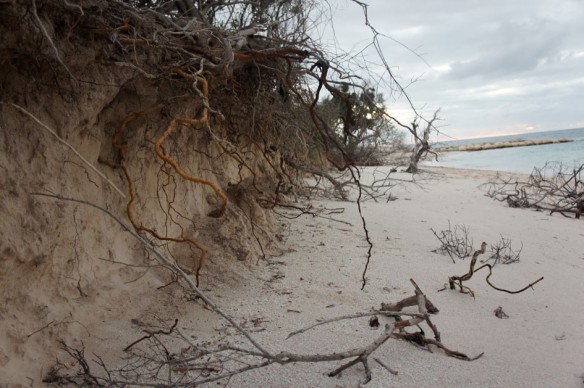
Pine tree about to fall into the ocean.

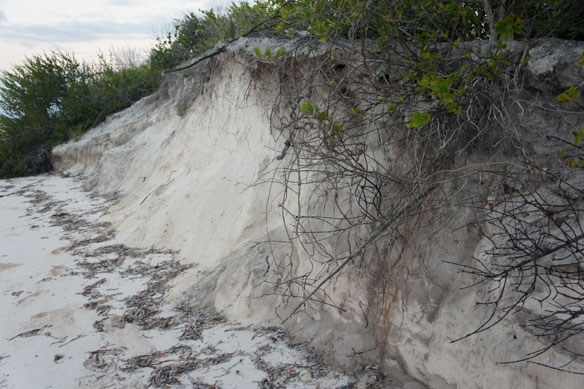
The area of concern is about half a kilometre long and in the last few days, between two to six metres of sand from the frontal dune has been washed away. The Tweed Shire Council has sandbagged an area of beach worst affected by erosion to little effect.

The situation was made worse this week when heavy rain and unruly surf tore more trees and sections of park into the ocean.

Kingscliff
Many tress are being swallowed by the ocean. According to Tania Phillips, “Seen from the protective fence next to the road looking back towards the creek at Kingscliff on June 16. As you can see its about a metre or two away from the road. Two months later its about a metre or two the other side of the road.”

In the wake of the damage, a spokesman for NSW Lands Minister Tony Kelly said the ‘naturally occurring’ erosion was predominantly a matter for council. However, he had commissioned a feasibility study to examine whether pumping sand from either the Tweed River or Cudgen Creek would help protect the beach and park.

”The authority continues to discuss options with Tweed Shire Council for long term rebuilding and nourishment of Kingscliff Beach.”

Dismayed local Sue Bryan said she believed there was little that could be done to protect the park from further damage. ”It’s just tragic,” she said.

”I’m part of a group which goes swimming near the Coast Guard tower each morning and we have watched it get worse and worse over the last six months.

”Unfortunately, I think it’s just Mother Nature. They can try everything they want but it’s just going to keep happening.”

Kingscliff
Beach access is denied.

Slideshow, ABC

Original Article

Related Posts

Tags: , ,

1 Comment to “Kingscliff Battles Beach Erosion, Australia”

  • Hi,
    This can be better managed with a product that Council are aware of. It has been used around the World and is eco-friendly. Unfortunately, the only remedy they seem to entertain are sand bags that are not biodegradable. When these get damaged, bits float off into the Ocean where they can be mistaken as jellyfish and are eaten by Tutrles and the likes at their peril. ie. pollutant.
    Someone needs to consider this environmental possible catastrophe.
    Lots of other methods have been tried and not been succesful and I can not see thre reluctance to try this tried and tested method.

Post comment

You do not have the Flash plugin installed, or your browser does not support Javascript (you should enable it, perhaps?)


Coastal Care junior
The World's Beaches
Sand Mining
One Percent