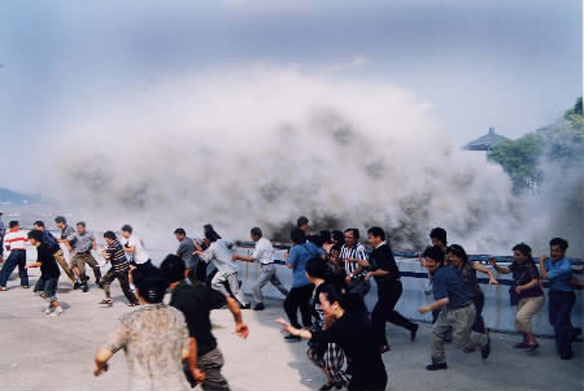
Famous Qiantang River Tidal Bore in China

CCTV news 25/09/2010, on You Tube.
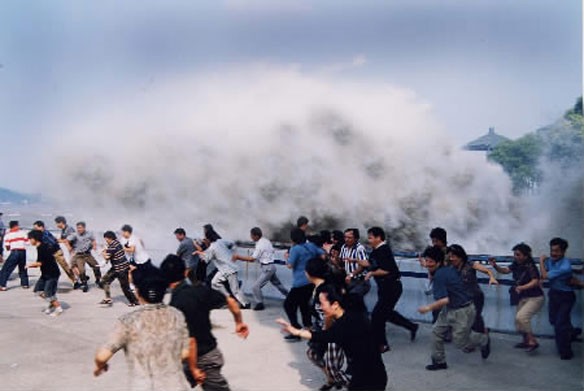
People witnessed the most impressive tidal bore in east China’s Zhejiang Province, on Sept. 25, 2010. This tidal bore is the biggest in 8 years.

Tourists watch the tidal bore of the Qiantang River, in Yanguan Town of Haining, east China’s Zhejiang Province, on Sept. 25, 2010. (Xinhua/Huang Zongzhi)
2-meter tidal bore marks start of flood period for Qiantang River
Haining (Chinese: 海宁市) is a city in Zhejiang Province. It is 125 kilometers west of Shanghai.Zhejiang (Chinese: 浙江; pinyin: Zhèjiāng; Wade–Giles: Che-chiang) is an eastern coastal province of the People’s Republic of China. The word Zhejiang (crooked river) was the old name of the Qiantang River, which passes through Hangzhou, the provincial capital. The name of the province is often abbreviated to “Zhe” (浙).
Haining is home to one of China’s most spectacular sights, the Qiantang River tides, Lu Hong reports. Millions of people from China and overseas are drawn to the city of Haining in Zhejiang province every year to witness one of China’s most unusual and spectacular sights – the amazing surging tides of the Qiantang River.
The extraordinary tides presented by the Qiantang River are a world-renowned natural wonder caused by gravitational pull. The centrifugal force produced by the rotation of the earth and by the peculiar bottleneck shape of Hangzhou Bay makes it easy for the tide to come in, but difficult for it to ebb. This amazing natural phenomenon is an incredible spectacle and visitors from around the world flock to witness it.

The Qiantang River is the biggest in Zhejiang province, running from the west to Hangzhou Bay in the east. It serves as a river hinge, playing an important role in water transportation between east and west.
The tide, which has a crest as high as 3.5 meters, causes the river’s water to explode over the shoreline. Only the mouth of the Amazon River in South America can create tides on this scale.
An international tide watching festival has been held annually since 1994 and has attracted millions of domestic and overseas tourists.

There are three spots in the city suitable for tide watching: Dingqiao Daquekou, to watch where two tidal waves collide; Yanguan Park, for viewing tidal waves roll into the shore; and Lao Yan Cang, to watch the waves crash into the 9-meter walls of Dingzi Dam.
Yanguan tide watching park is the favorite area for wave-watching tourists. Since 1994, Haining has held a tidal wave watching festival, the day when the most spectacular tides and biggest waves are seen.
The most violent tidal waves are seen each year along the river during the 18th day of the eighth month of the Chinese Lunar calendar, which falls on September 25 this year. Every year more than 1 million people from all over the world gather in Haining during this time to watch the tides.
Scientists have rightly predicted that this year’s waves would be the highest in eight years. However, tourists are warned that tidal watching can be dangerous. Due to the gravitational force created by the tides, people can be sucked into the water even when standing three meters away from the waves. Every year at least a dozen wave viewers are drowned in the huge waves. So tourists are warned not to enter the sign-posted restricted area.
At the Qiantang River on Sept. 24 the tidal bore, a name for a large column of water produced by the tide, reached as high as 1.9 meters, marking the start of the autumn flood period of the river.
Tidal Bore:Tsunami-Like River Tides Are Surfing’s New Frontier National Geographic
By Karin Muller, The National Geographic.
It’s the tail end of the dry season on the Araguari River in the Brazilian Amazon Basin, and the water level is low. The moon is full. Suddenly an ominous roar rolls through the jungle, like the rumble of an oncoming train. A vast wall of water comes hurtling straight up the river. The native Tupi Indians call it poroc-poroc—big roar.
Is it a tsunami? No. It’s a tidal bore.
The phenomenon is “a wave that forms at the head of the incoming tide in certain rivers or estuaries,” explains tidal bore surfer and researcher Tom Wright of the Tidal Bore Research Society Web site. “It is the product of the tide wave and should not be confused with a [tsunami].”
A tidal bore can travel in excess of 20 miles an hour (30 kilometers an hour) and gets stronger as the river gets narrow and shallower, reaching recorded heights of up to 30 feet (9 meters). The pororoca, as the bores are known in the Brazilian Amazon, has been sighted over 180 miles (300 kilometers) inland on the Rio Guajara.
“Two principal factors affect the size and strength of bores,” said Victor Miguel Ponce, a professor in the civil and environmental engineering department at California’s San Diego State University. “The magnitude of the tidal range and the shape of the river at its estuary.”
The Earth’s tides are caused by the gravitational attraction of both the sun and moon on the Earth’s waters. Two high tides occur every 24 hours, one on the side of our planet that is closest to the moon and the other on the side that is farthest away.
Since the sun is nearly 40 times farther from the Earth than the moon, solar tides have a smaller, though still measurable, effect. High spring tides occur whenever the Earth, moon, and sun line up and reinforce each other. These tides fall after both the new and full moon.
Weather and coastal effects also have a local and often unpredictable effect on tides. Strong winds sweeping in from the sea can cause water to pile up against the shore, leading to higher-than-expected water levels. “Extreme meteorological conditions leading to a storm surge can also produce a tidal bore in a river that may under normal conditions not exhibit one,” Wright said.
But not every river has a bore, no matter how spectacular the local tides. “For a bore to occur, the shape of the river at its estuary—near its mouth—has to be shallow and uniform,” with just the right water depth to accommodate the incoming wall of water, Ponce noted.
In the open ocean a tide wave is symmetrical. “As it encounters shallow water near shore, the crest [highest point] travels at a greater speed than the base, causing the wave to steepen,” he said. Once the crest overtakes the trough, the peak sharpens. A discernible head wave is formed and a bore is born.
Famous Bores
In fact, tidal bores only occur in an estimated 100 rivers in the world and only during extreme tidal ranges. A few of these bores have developed famous and sometimes deadly reputations.
The largest, according to the Guinness Book of Records, is the Qiantang River tidal bore in China. It can reach a height of 29.2 feet (8.9 meters) and a speed of 25 miles an hour (40 kilometers an hour).
It is locally known as the Silver (or Black) Dragon. Each year a tidal-bore-watching festival is held around the 18th day of the Chinese lunar calendar in September, when the bore is at its largest.
The Severn River in the United Kingdom has over 250 bores a year. The phenomenon has been known to carry surfers upriver for up to six miles (ten kilometers).
The Lupar Benak bore in Sarawak, Malaysia, nearly drowned the British writer Somerset Maugham during a visit to the Rajah in 1949.
But one of the most fascinating bores is the pororoca in Brazil.
Surf’s Up!
Not everyone runs for cover when the big roar is heard on the banks of the Amazon River. In 1997, for the first time, a group of intrepid surfers grabbed their boards to see if they could ride the wall of water.
But tidal bore surfing is not for amateurs. The Silver Dragon in China is so dangerous that no one has managed to remain upright on it for more than 11 seconds.
The pororoca has its own set of challenges, according to Serginho Laus, a professional Brazilian surfer and journalist who has conquered many tidal bores.
“The wave is very powerful and can destroy anything—trees, local houses, islands … and sweeps up wild animals, like snakes—the anaconda—alligators, spiders, piranha, and even jaguar,” said Serginho, who once broke his back trying to surf the pororoca.
Add to those risks the candiru (Vandellia cirrhosa), a small parasitic fish that can swim up a person’s urethra, dig in its spines, and feast on its host’s blood. The invader can only be removed by surgery.
So why do Serginho and his fellow surfers brave the muddy and dangerous waters of the world’s tidal bores?
“You can see the jungle and ride the longest wave in the world … more than 10, 20, 30, 40 minutes,” he says with barely contained enthusiasm. “The best pororoca is in Maranhao—Mearim River … perfect … with tubes!”—surfer slang for the rounded hollows formed by breaking waves.
In April Serginho will head for the Amapa, the longest and most dangerous pororoca—to try to break Adilton Mariano’s record ride of 36 minutes. In the meantime, the sport of bore surfing is becoming more and more popular, with charters providing trips to even the most inaccessible Amazonian rivers.
Which means surfers are now facing a new and completely unexpected danger in the jungles of Brazil—overcrowding.