Scientists find damage to coral near BP well

oiled-coral
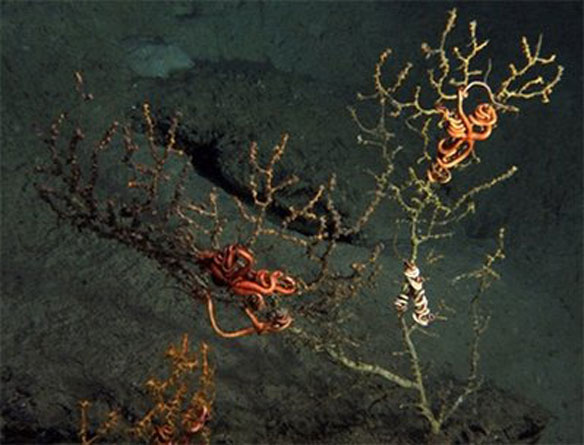
The large areas of darkened coral and other damaged marine organisms were almost certainly dying from exposure to toxic substances, scientists said.
Image Source: Lophelia II 2010, NOAA OER and BOEMRE.

By Cain Burdeau, The Associated Press

For the first time, federal scientists have found damage to deep sea coral and other marine life on the ocean floor several miles from the blown-out BP well, a strong indication that damage from the spill could be significantly greater than officials had previously acknowledged.

The corals were discovered by scientists aboard a National Oceanic and Atmospheric Administration research vessel using a submersible robot equipped with cameras and sampling tools.

Tests are needed to verify that the coral died from oil that spewed into the Gulf of Mexico after the Deepwater Horizon rig explosion, but the chief scientist who led the government-funded expedition said Friday he was convinced it was related.

“What we have at this point is the smoking gun,” said Charles Fisher, a biologist with Penn State University who led the expedition aboard the Ronald Brown, a National Oceanic and Atmospheric Administration research vessel.

“There is an abundance of circumstantial data that suggests that what happened is related to the recent oil spill,” Fisher said.

For the government, the findings were a departure from earlier statements. Until now, federal teams have painted relatively rosy pictures about the spill’s effect on the sea and its ecosystem, saying they had not found any damage on the ocean floor.

In early August, a federal report said that nearly 70 percent of the 170 million gallons of oil that gushed from the well into the sea had dissolved naturally, or was burned, skimmed, dispersed or captured, with almost nothing left to see, at least on top of the water. The report was blasted by scientists.

Most of the Gulf’s bottom is muddy, but coral colonies that pop up every once in a while are vital oases for marine life in the chilly ocean depths.

Coral is essential to the Gulf because it provides a habitat for fish and other organisms such as snails and crabs, making any large-scale death of coral a problem for many species. It might need years, or even decades, to grow back.

“It’s cold on the bottom, and things don’t grow as quickly,” said Paul Montagna, a marine scientist at the Harte Research Institute for Gulf of Mexico Studies at Texas A&M University in Corpus Christi. He was not on the expedition.

Montagna said the affected area is so large, and scientists’ ability to explore it with underwater robots so limited that “we’ll never be able to see everything that happened down there.”

Using a robot called Jason II, researchers found the dead coral in an area measuring up to 130 feet by 50 feet, about 4,600 feet under the surface.

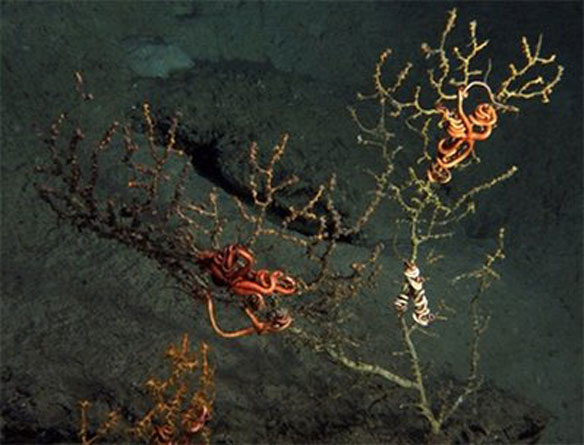
Coral Near BP Well
Branches of coral, with brittle starfish attached, several miles from the site of the blown-out BP well in the Gulf of Mexico. Image Source: Lophelia II 2010, NOAA OER and BOEMRE

“These kinds of coral are normally beautiful, brightly colored,” Fisher said. “What you saw was a field of brown corals with exposed skeleton, white, brittle stars tightly wound around the skeleton, not waving their arms like they usually do.”

Fisher described the soft and hard coral they found seven miles southwest of the well as an underwater graveyard.

He said oil probably passed over the coral and killed it.

The coral has “been dying for months,” he said. “What we are looking at is a combination of dead gooey tissues and sediment. Gunk is a good word for what it is.”

Eric Cordes, a Temple University marine scientist on the expedition, said his colleagues have identified about 25 other sites in the vicinity of the well where similar damage may have occurred. An expedition is planned for next month to explore those sites.

When coral is threatened, its first reaction is to release large amounts of mucus, “and anything drifting by in the water column would get bound up in this mucus,” Cordes said. “And that is what this (brown) substance would be: A variety of things bound up in the mucus.”

About 90 percent of the large coral was damaged, Fisher said.

The expedition was funded by the Bureau of Ocean Energy Management and the National Oceanic and Atmospheric Administration. The mission was part of a four-year study of the Gulf’s depths, but it was expanded this year to look at oil spill damage.

In a statement released Thursday night, NOAA Administrator Jane Lubchenco said the expedition underscored that the damage to marine life from the oil spill is “not easily seen.” She added that more research was needed to gain a “comprehensive understanding of impacts to the Gulf.”

“Given the toxic nature of oil, and the unprecedented amount of oil spilled, it would be surprising if we did not find damage,” she said.

NOAA did not provide any officials or scientists of its own who went on the expedition. The Bureau of Ocean Energy Management said its researcher on the expedition was unavailable.

Cordes said that the expedition did not find dramatic visual evidence of coral damage in other sites north of the well. But he said it was premature to say coral elsewhere in the Gulf was not damaged.

The new findings, though, could mean long-term trouble for the coral southwest of the well, where computer models and research cruises mapped much of the deepwater oil.

Referring to one type of coral known as “gorgonians,” Cordes said he had never seen them “come back from having lost so much tissue. It would have to be re-colonization from scratch.”

Original Article

Related Posts

Tags: , ,

Post comment

Resources

Federal

  • Deep Water Horizon Response is the official site of the incident in conjunction with BP, DOI, NPS, USGS, CDC, USFWS, NOAA and other branches of the US government (collectively called Unified Command). Information, including the latest news, photos, area plans, and volunteer information.
  • NOAA is a government program that uses science and research to protect life, property and natural resources. This NOAA site provides maps of the spill and related statistics, including a trajectory forecast map for the oil spill.
  • The Environmental Protection Agency provides data on Air, Land, and Water pollutants including sampling maps and contaminant levels.

Louisiana

  • Volunteer Louisiana is the official site for the State of Louisiana to get involved in the spill response.
  • The Louisiana Department of Wildlife and Fisheries provides maps of closures to fishing areas in LA.
  • The Louisiana Emergency Office has made Google Earth files of the spill available to the public here http://gohsep.la.gov/oilspill.aspx and also has current information on general closures of waterways, photos, and reports.
  • The Audubon Nature Institute site provides a number for citizens to call if turtles, manatees, dolphins, or other animals are in distress
  • The Oiled Wildlife Care Network is a CA based non-profit is advising folks in the Gulf of Mexico on best practices and provide resources on how people can help.
  • The Coalition to Restore Coastal Louisiana is a non-profit organization who strive to protect and restore coastal Louisiana. Volunteers are needed for numerous actions including: monitoring, oiled wildlife recovery, boat driving, or simple monetary donations.
  • The Greater New Orleans Foundation is a philanthropic organization in Louisiana and the surrounding region that joins with other non-profit, foundations and community and government officials to address the needs of the community. The Foundation has opened the Gulf Coast Oil Spill Fund.
  • The Louisiana Bucket Brigade is an environmental health and justice organization working with communities near oil refineries and chemical plants. They aid residents in these regions to reduce pollution and protect public health. The Brigade has formed an incident map where you can report observed signs of oil.

Alabama

  • The Alabama Coastal Foundation is an education based organization whose mission is to project the quality of Alabama’s coastal resources. They are currently training volunteers to help directly with the spill response.
  • The site by the Alabama Governor’s Office of Faith-Based and Community Initiatives gives basic phone numbers.
  • The Mobile Bay National Estuary Program is an organization funded by the EPA fighting the environmental challenged facing Mobile Bay. This site gives e-mail addresses and phone numbers to help and provides basic information.
  • The Mobile Bay Keeper is a group of citizens who are interested in preserving the Mobile Bay watershed as well as protecting the health of the individuals and environment in the Bay. Check out the latest information about the spill and learn how to become a member and donate to the cause.

Mississippi

Florida

  • The Florida Department of Environmental Protection is the lead agency in FL and this website provides the most thorough information in the state.
  • Volunteer Florida, the website of the Governor’s Commission on Volunteerism and Community Service and the State Emergency Response Team, lists volunteer opportunities by county.
  • The Escambia County site provides summary points of actions taken by BP and FL with a focus on the County.
  • The Pinellas County site is a concise list of related local websites and numbers for information.
  • The Gulf County site has current news on the spill as it relates to the county
  • Volunteer directly with the largest wild bird hospital in the United States, the Suncoast Seabird Sanctuary.

Organizations and other networks

  • American Birding Association
  • Audubon is a global leader in protecting birds and other wildlife and their habitats. They are partnering with other organizations.
  • The Sierra Club is a grassroots environmental organization that works to protect communities, wild places, and the planet. Updates on the oil spill, as well as volunteer and donation information.
  • The Nature Conservancy is a conservation organization with a mission to preserve and protect ecologically significant lands and waters for nature and people. Learn more about the oil spill and how to help out at http://www.nature.org/wherewework/northamerica/states/alabama/features/oilspill.html and check out their blog.
  • Sea Grant is nationwide network (administered through NOAA) of 32 university-based programs that work with coastal communities on environmental stewardship and the responsible use of our coasts. The Gulf of Mexico Sea Grant Programs provides resources to educators with research that may be impacted by the spill.
  • The National Wildlife Federation is America’s largest conservation organization whose mission is to protect and restore wildlife habitat, confront global warming and connect with nature. Get the latest information on the oil spill crisis and how to help.
  • The mission of Tri-State Bird Rescue and Research is to provide rehabilitation of injured, orphaned, and oiled native wild birds to return to their natural environment. Donate to their research.
  • Green Peace is an international organization that strives to save the planet from environmental threats such as global warming, destruction of forests and deterioration of the oceans. Follow their blog and learn how to take action.
  • Global Green USA is an international environmental non-profit organization with an office in New Orleans that strives to fight global climate change, eliminate weapons of mass destruction and create clean, safe drinking water for all. Follow their blog and get involved.
  • Matter of Trust is a non-profit organization focused on materializing sustainable systems by mimicking Mother Nature as well as concentrating on manmade surplus, natural surplus and eco-educational programs. Learn very simple ways to help the oil spill crisis.
  • The official Facebook page of Unified Command.
  • BP Gulf of Mexico response.