Inform
The health, beauty and ecosystem of our beaches is under threat
The driving cause for most of these problems is overdevelopment and poor coastal management. If no buildings crowded the shoreline, there would be no shoreline armoring, beach nourishment, threats to the beach fauna and flora or shoreline erosion problems.
Coastal Care Introduction
“Beach sand: so common, so complex, so perfect for sandcastles; and now it is a precious and vanishing resource.”
—Orrin H. Pilkey
Beaches are the most visited natural attraction on the planet. The coast attracts millions of vacationing people each year. People love the sand, the surf, the sea breeze, and the vacation ambiance so much that many come to the beach to stay. There is a magical feeling living near the ocean, but human migration towards the coast comes with a high environmental price tag.
A majority of the world’s population lives within 50 km of the coast and the projections are 75% by the year 2025. This strip of land represents only 3% of the total land mass of the planet. In this context, it is easier to understand the environmental impact. Over 70% of the earth is covered by water and with so many people living on the coast, we are polluting a major source of food, the oceans.
A beautiful undeveloped beach in Indonesia.
The loss of life and economic impacts of major storms – cyclones, typhoons, and hurricanes – and tsunamis would be reduced drastically if beaches were not developed. Unfortunately, recent examples of the problem are numerous: 1999 Indian cyclone Orissa (over 10,000 dead and $5 billion in damage), 2004 Indian Ocean tsumani (over 250,000 dead), 2005 Hurricane Katrina (over 1,800 killed and $80 billion in damage), and 2008 Hurricane Ike (over 30 killed and $30 billion in damage).
Today, the health, beauty, and ecosystem function of the world’s beaches are under threat and the driving causes for most of these problems are over-development and poor coastal management. If no buildings crowded the shoreline there would be no shoreline armoring, beach nourishment, threats to the beach fauna and flora or shoreline erosion problems.
It is important to distinguish between erosion and erosion problems. Erosion refers to the landward retreat of the shoreline. Most of the world’s shorelines are eroding, a very few are building out (accreting). There is no erosion problem, however, until someone builds something next to a shoreline. All over the world in remote areas, shorelines are slowly retreating and no one cares. In a global sense, our continents are slowly shrinking, and in a very real sense, erosion problems are man made. On a high-rise, condo-lined shoreline like those in Spain and the Florida coast, erosion is a huge problem and will only worsen in the future as sea level rise accelerates. Sea level rise will accelerate erosion of the shoreline and have a dramatic impact on our infrastructures, our economies, and our way of life.
Sea level rise is one of the most important causes of global shoreline erosion. If the coastline is developed, shoreline armoring is often used in an effort to save the buildings from the eroding shoreline. Once this begins, the beaches will degrade and eventually be lost. In the long-term, however, these armoring efforts are in vain. The ocean will continue to rise as the rate of sea level rise is expected to increase as the Greenland and Antarctic ice sheets continue to degrade. The situation is made worse now because beach houses and condominiums are being built closer to the ocean than they were 25 years ago. Many of us are familiar with images of large beach houses about to fall victim to the oceans simply from daily erosion accelerated by the ever rising sea.
The work of the Santa Aguila Foundation will emphasize the impacts of sand mining and shoreline armoring: the first because the effects of sand mining have been largely ignored on a global scale and the latter due to its overwhelming negative impacts on the world’s beaches.
Surfing in / Inform
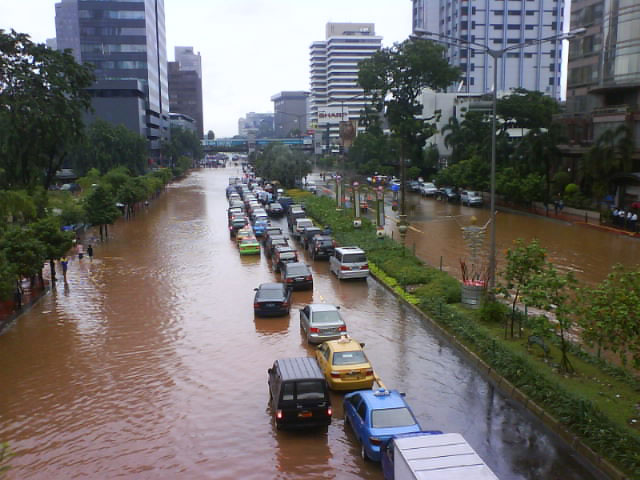
Thailand floods’ Shut Down Bangkok’s Second Airport
Advancing floodwaters in Thailand breached barriers protecting Bangkok’s second airport, in Don Muang, Tuesday. Don Muang has come to symbolize the gravity of the Southeast Asian nation’s deepening crisis, which has seen advancing waters drown a third of the country and kill 366 people over the last three months.
Up to 20 million tons of debris from Japan’s tsunami moving toward Hawaii
Up to 20 million tons of debris from the Japanese earthquake and tsunami in March, is traveling faster than expected and could reach the U.S. West Coast in three years. The marine debris were recently spotted by a Russian ship’s crew.
NZ, Almost 500 Tonnes Of Oil Pumped From Rena Cargo Ship
481 tonnes of oil has been pumped from the stricken ship Rena, which originally held 772 tonnes of oil, as the salvage operation accelerates. 10 tonnes of fuel oil escaped the beleaguered ship on Saturday night and yesterday morning, and was being swept north by the tide, towards Mayor Island, a wildlife refuge and marine reserve.
Stressors To Florida Keys Marine Ecosystem, A Study
NOAA scientists have found that pressure from increasing coastal populations, ship and boat groundings, marine debris, poaching, and climate change are critically threatening the health of the Florida Keys ecosystem. Many historically abundant marine resources such as green sea turtles and coral habitat continue to be at risk with low rates of recovery.
Loving the Chambered Nautilus to Death
It is a living fossil whose ancestors go back a half billion years, to the early days of complex life on the planet, when the land was barren and the seas were warm. Nautilus lives on the slopes of deep coral reefs in the warm southwestern Pacific, but scientists say humans are loving the chambered nautilus to death, throwing its very existence into danger.
Bioluminescence: Explanation for Glowing Waves Suggested
It has long been known that distinctive blue flashes, a type of bioluminescence, that are visible at night in some marine environments are caused by tiny, unicellular plankton known as dinoflagellates. However, a new study has, for the first time, detailed the potential mechanism for this bioluminescence.
Accumulation of Microplastic on Shorelines Woldwide: Sources and Sinks
Scientists are reporting that household washing machines seem to be a major source of so-called “microplastic” pollution, bits of polyester and acrylic smaller than the head of a pin, that they now have detected on the shorelines at 18 sites worldwide representing six continents from the poles to the equator, with more material in densely populated areas.
Hawaii’s coral reef ecosystems worth $33.57 billion per year
A peer-reviewed study commissioned by NOAA shows the American people assign an estimated total economic value of $33.57 billion for the coral reefs of the main Hawaiian Islands.
Radiation Risk at Scots Beach Worse Than Thought, Says Report
Highly radioactive material have been found on the popular Dalgety Bay beach, Scotland, giving great “cause for concern”, especially for children, exposed to radioactive pollution from the beach, a study by the Scottish Environmental Protection Agency (Sepa) just revealed.