Inform
The health, beauty and ecosystem of our beaches is under threat
The driving cause for most of these problems is overdevelopment and poor coastal management. If no buildings crowded the shoreline, there would be no shoreline armoring, beach nourishment, threats to the beach fauna and flora or shoreline erosion problems.
Coastal Care Introduction
“Beach sand: so common, so complex, so perfect for sandcastles; and now it is a precious and vanishing resource.”
—Orrin H. Pilkey
Beaches are the most visited natural attraction on the planet. The coast attracts millions of vacationing people each year. People love the sand, the surf, the sea breeze, and the vacation ambiance so much that many come to the beach to stay. There is a magical feeling living near the ocean, but human migration towards the coast comes with a high environmental price tag.
A majority of the world’s population lives within 50 km of the coast and the projections are 75% by the year 2025. This strip of land represents only 3% of the total land mass of the planet. In this context, it is easier to understand the environmental impact. Over 70% of the earth is covered by water and with so many people living on the coast, we are polluting a major source of food, the oceans.
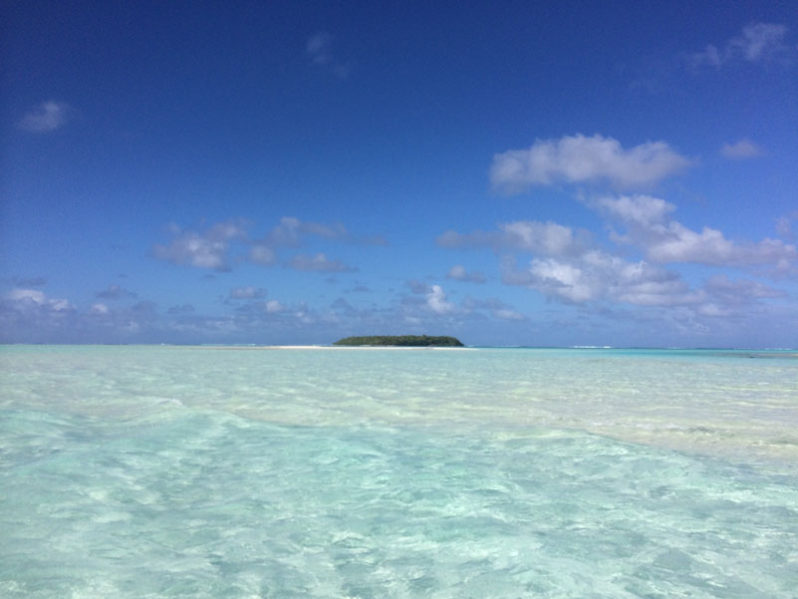
A beautiful undeveloped beach in Indonesia.
The loss of life and economic impacts of major storms – cyclones, typhoons, and hurricanes – and tsunamis would be reduced drastically if beaches were not developed. Unfortunately, recent examples of the problem are numerous: 1999 Indian cyclone Orissa (over 10,000 dead and $5 billion in damage), 2004 Indian Ocean tsumani (over 250,000 dead), 2005 Hurricane Katrina (over 1,800 killed and $80 billion in damage), and 2008 Hurricane Ike (over 30 killed and $30 billion in damage).
Today, the health, beauty, and ecosystem function of the world’s beaches are under threat and the driving causes for most of these problems are over-development and poor coastal management. If no buildings crowded the shoreline there would be no shoreline armoring, beach nourishment, threats to the beach fauna and flora or shoreline erosion problems.
It is important to distinguish between erosion and erosion problems. Erosion refers to the landward retreat of the shoreline. Most of the world’s shorelines are eroding, a very few are building out (accreting). There is no erosion problem, however, until someone builds something next to a shoreline. All over the world in remote areas, shorelines are slowly retreating and no one cares. In a global sense, our continents are slowly shrinking, and in a very real sense, erosion problems are man made. On a high-rise, condo-lined shoreline like those in Spain and the Florida coast, erosion is a huge problem and will only worsen in the future as sea level rise accelerates. Sea level rise will accelerate erosion of the shoreline and have a dramatic impact on our infrastructures, our economies, and our way of life.
Sea level rise is one of the most important causes of global shoreline erosion. If the coastline is developed, shoreline armoring is often used in an effort to save the buildings from the eroding shoreline. Once this begins, the beaches will degrade and eventually be lost. In the long-term, however, these armoring efforts are in vain. The ocean will continue to rise as the rate of sea level rise is expected to increase as the Greenland and Antarctic ice sheets continue to degrade. The situation is made worse now because beach houses and condominiums are being built closer to the ocean than they were 25 years ago. Many of us are familiar with images of large beach houses about to fall victim to the oceans simply from daily erosion accelerated by the ever rising sea.
The work of the Santa Aguila Foundation will emphasize the impacts of sand mining and shoreline armoring: the first because the effects of sand mining have been largely ignored on a global scale and the latter due to its overwhelming negative impacts on the world’s beaches.
Surfing in / Inform
Plastic Found in Nine Percent of North Pacific Garbage Patch Fishes
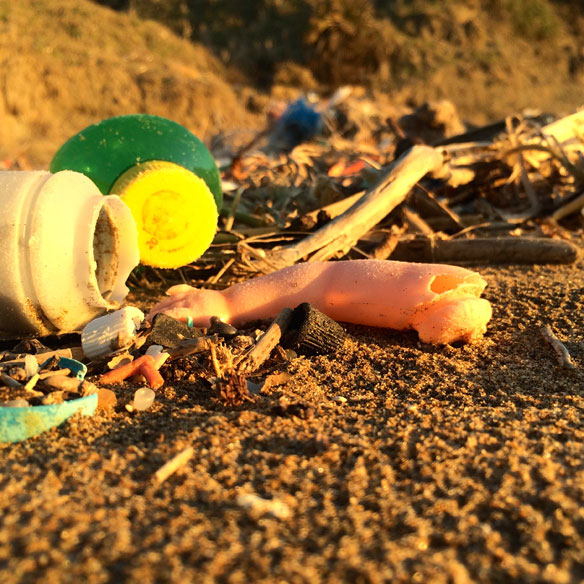
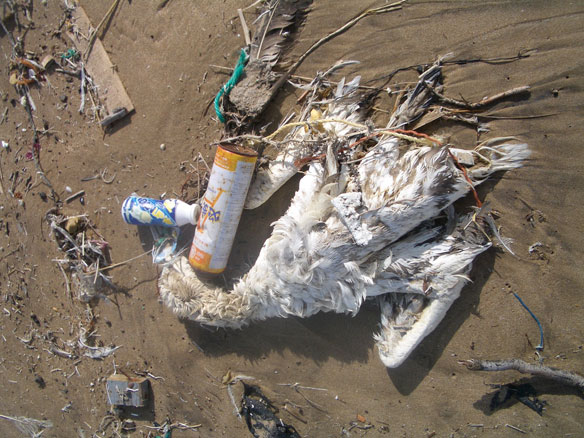
The first scientific results from the 2009 SEAPLEX voyage, offer a stark view of human pollution and its infiltration. It is estimated that fish in the intermediate ocean depths of the North Pacific, ingest plastic at a rate of roughly 12,000 to 24,000 tons per year…
Our Expanding Oceans, and Global Climate Change: A Primer
Our Expanding Oceans exhibit is based on a new book, “Global Climate Change: A Primer,” written by renowned climate scientist Orrin Pilkey and son Keith Pilkey. To visually emphasize the effects of climate change, the book is illustrated with Mary Edna Fraser’s striking batik paintings. The exhibit featuring over 50 batiks on silk, opened at the North Carolina Museum of Natural Sciences.
Testing The Waters and The US Beaches
NRDC’s annual survey of water quality and public notification at U.S. beaches finds that the number of beach closings and advisories in 2010 reached 24,091, the second-highest level since NRDC began tracking these events 21 years ago.
Sand Dredging Operations Of “Unprecedented Scale,” Cambodia
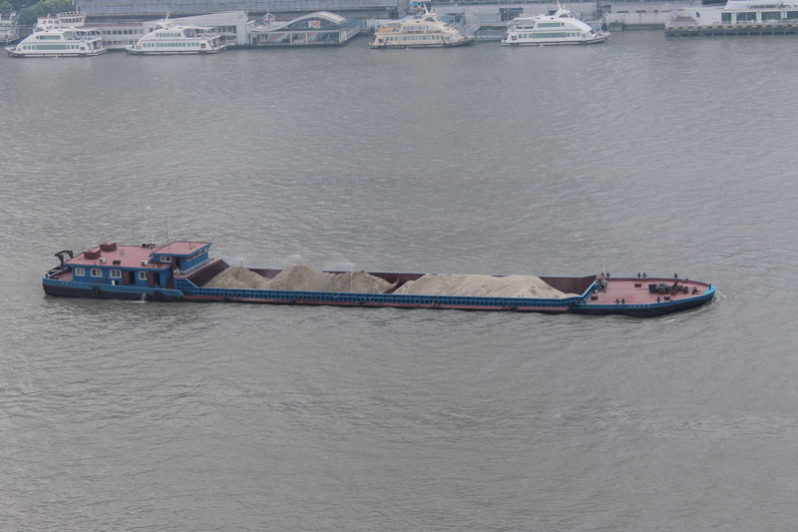
Sand dredgers have resumed operations of “unprecedented scale” in Koh Kong province’s salt-water estuaries since May, after a drop-off in dredging activities as a result of a 2009 sand-export ban.
Average U.S. temperature increases by 0.5 degrees F
The climate of the 2000s is about 1.5 degree F warmer than the 1970s.
Newspaper Archives Help to Understand Coastal Flooding
A unique study using over 70 years of information from local newspapers has helped to examine the incidence and location of coastal floods in the Solent region of southern England.
Islands Going Under, The Carteret Islands
The Carteret Islands off the coast of Papua New Guinea are drowning… What should have been an idyllic South Pacific paradise, is rapidly turning into a climate change disaster site.
Study details significant sea level rise
Since the late 19th century, sea level has risen by more than 2 millimeters per year on average, the steepest rate for more than 2,100 years. The new study does not predict the future, yet it does show “there is a very close link between sea level and temperature. So for the 21st century when temperatures will rise, so will sea level.”
Ongoing Sand Mining Mafia, Konkan coast, India
Sand mining had come to a near standstill last year after the Bombay High Court banned it, however Maharashtra’s creeks and the Konkan coast and beaches do remain prey to the sand mafia.