Sea Level Rise

Accelerated erosion

View Sea Level Rise Gallery

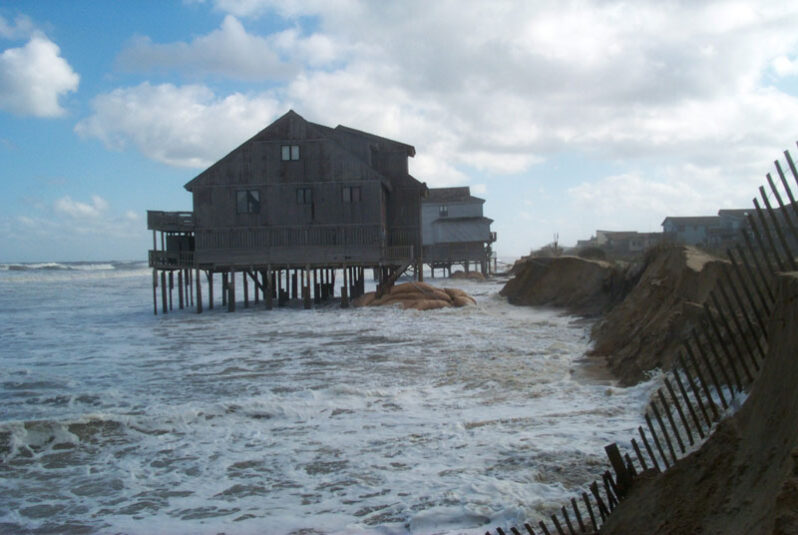
There will always be beaches, but sea level rise will ensure that they will not be in the same place in the future. The beaches will still exist throughout this change, but many of the buildings may not. Efforts to save development, however do threaten beaches, such as shoreline armoring structures.

Although relative amounts of rise may seem very small, only a few millimeters per year, the cumulative effect of these small rises each year over a long period of time (100+ years) causes major problems. Accelerated rates of erosion are attributed to sea level rise and erosion causes large economic losses around the world each year due to the close proximity of buildings and critical infrastructure. This includes transportation systems, gas and oil lines as well as electricity lines and power plants.

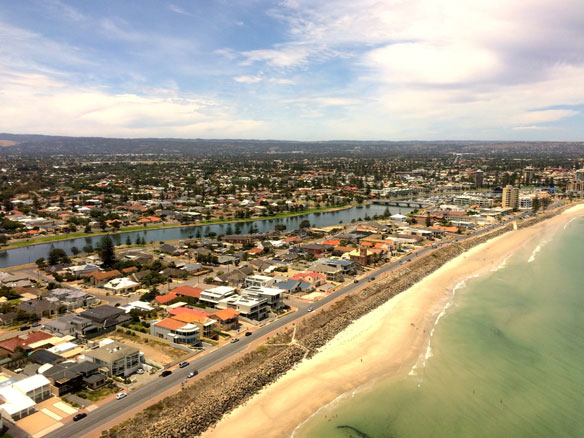
Most developed coasts and beaches have buildings very close to the ocean leaving little room for the ever-expanding ocean. The future effects of sea level rise on coastal civilization over the entire world are of great concern. Over half of the world’s population lives within 100 km of the coast. Over the next 50 years, damage due to coastal development will be devastating, but if the rate of sea level rise increases, the results could be catastrophic. This issue threatens areas from New York City in the United States to the Pearl River Delta in China to the Maldives.

The world map below allows you to see elevations of coastal areas. Areas in red are the lowest in elevation and are most prone to flooding. Check out Manhattan in New York City. If you think the situation there looks dire, be sure to check out the effects of a 2 m rise in sea level on Pearl River Delta in China, home to more than 40 million people. Map courtesy of globalwarmingart.com


Surfing in / Sea Level Rise

Strong El Niño could bring increased sea levels, storm surges to U.S. East Coast

coastal-wetlands-slr

Coastal communities along the U.S. East Coast may be at risk to higher sea levels accompanied by more destructive storm surges in future El Niño years, according to a new study by NOAA.

No comments

Forests soak up third of fossil fuel emissions: study

mangrove

An international team of climate scientists released a study showing the role global forests have played as regulators of the atmosphere. This is the first complete and global evidence of the overwhelming role of forests in removing anthropogenic carbon dioxide.

No comments

US West Coast Erosion Spiked In Winter 2009-10, Previewing Likely Future As Climate Changes

usgs-sf4

Knowing that the U.S. west coast was battered during the winter before last by a climatic pattern expected more often in the future, scientists have now pieced together a San Diego-to-Seattle assessment of the damage wrought by that winter’s extreme waves and higher-than-usual water levels.

No comments

Shifting Sands and Rising Seas

Screen shot 2011-07-11 at 4.53.13 PM

“In a time of rising seas, it is senseless and dangerous to build on barrier islands.” World-renowned coastal geologist Orrin H. Pilkey and artist Mary Edna Fraser, an internationally recognized master of the textile art of batik, bring an understanding of coastal geology and global change to the public in a way that is scientifically astute and visually intriguing. By Celie Daily and Orrin Pilkey.

No comments

Australia Carbon Pollution Tax Announcement: A Start!

maldivian-flag-slr

Australia Prime Minister Julia Gillard, is on Sunday due to unveil the full detail of her carbon tax legislation, which will see the country’s top 500 polluters charged per tonne of carbon dioxide they emit into the atmosphere.

No comments

Our Expanding Oceans, and Global Climate Change: A Primer

primer

Our Expanding Oceans exhibit is based on a new book, “Global Climate Change: A Primer,” written by renowned climate scientist Orrin Pilkey and son Keith Pilkey. To visually emphasize the effects of climate change, the book is illustrated with Mary Edna Fraser’s striking batik paintings. The exhibit featuring over 50 batiks on silk, opened at the North Carolina Museum of Natural Sciences.

No comments

Average U.S. temperature increases by 0.5 degrees F

noaa-2011-temp

The climate of the 2000s is about 1.5 degree F warmer than the 1970s.

No comments

Islands Going Under, The Carteret Islands

rising-sea2

The Carteret Islands off the coast of Papua New Guinea are drowning… What should have been an idyllic South Pacific paradise, is rapidly turning into a climate change disaster site.

No comments

Study details significant sea level rise

sea-level-rise

Since the late 19th century, sea level has risen by more than 2 millimeters per year on average, the steepest rate for more than 2,100 years. The new study does not predict the future, yet it does show “there is a very close link between sea level and temperature. So for the 21st century when temperatures will rise, so will sea level.”

No comments


Recent / Sea Level Rise

Voices for Change, Sydney Australia

coastline-nz

June 20th, 2011

“Billions of people will be affected by impacts of climate change… One of them is you.”

Read More

Cuba: Sea levels to rise more than 30 in. by 2100

cuba-train-to-atlantis

June 17th, 2011

Cuban scientists warn that right now it is urgent to preserve mangroves, coral reefs, sea grass and sand beaches. Each of these ecosystems is a natural barrier to defend the coasts from the impact of climate change and sea level rise. Most of the 400 beaches of Cuba’s territory are affected by erosion with a receding coastline estimated at 1.2 meters per year.

Read More

2011 Ashden Awards international finalists, in pictures

sustainable-energy

June 16th, 2011

Eight sustainable energy pioneers from Africa and Asia have been selected as international finalists for the prestigious Ashden Awards for sustainable energy 2011.

Read More

One million Bangladesh Homes on Solar Power

sea-level-rise-sundarbans-greenpeace

June 15th, 2011

The number of households in electricity-starved Bangladesh using solar panels has crossed the one million mark, the fastest expansion of solar use in the world.

Read More

Human Activities Produce More Carbon Dioxide Emissions Than Do Volcanoes

volcano-eruption

June 15th, 2011

On average, human activities put out in just three to five days, the equivalent amount of carbon dioxide that volcanoes produce globally each year.

Read More

Climate change: How do we know?

drought-earth

June 15th, 2011

The current warming trend is of particular significance because most of it is very likely human-induced and proceeding at a rate that is unprecedented in the past 1,300 years. In the meantime, the fate of the only international agreement that sets binding targets for curbing greenhouse gases is hanging by a thread…

Read More

Arctic Melt Raises Sea Levels and Reinforces Global Warming

melting-ice-nasa

June 14th, 2011

If you want to see global warming’s signature, look to the Arctic. Up north, the air is warming and the ice is melting. For two decades, scientists have predicted these things would happen as the Earth warms, and now we see that the Arctic is changing much as expected. Melting Arctic ice is also contributing significantly to sea level rise.

Read More

Salt Mapper For Climate Forecasts, NASA

aquarius-sea-salt-climate

June 5th, 2011

Today’s scientists have learned that they can harness salt- this invaluable mineral- to foresee the future of Earth’s climate.

Read More

Rising sea levels endangering Australia’s World Heritage-listed Kakadu wetlands,

ubirr-rock-art-sea-turtle

June 4th, 2011

A study released by Australia Government, finds that Kakadu National Park, a protected northern territory, half the size of Switzerland, is one of Australia’s “natural ecosystems most vulnerable to the impacts of climate change”, with higher oceans being a “serious risk” to its ecosystem.

Read More

Climate Change Impacts in China

china-east-coast

May 27th, 2011

The received wisdom used to be that climate change would have relatively little impact on China. But that views seems outdated.

Read More