By Terry Macalister, The Guardian, UK.
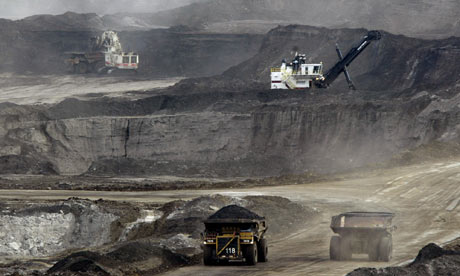
The successful development of Canada’s tar sands has triggered a rush by Shell and other oil companies to set up similar operations in Russia, Congo and even Madagascar, a new report reveals.
Soaring crude prices and an growing shortage of drilling sites have encouraged the energy industry to look at a series of “unconventional” hydrocarbon deposits threatening vulnerable environment and communities in places such as Jordan, Morocco as well as the US, Friends of the Earth says in a review called Tar sands – fuelling the energy crisis.
The revelations come just 24 hours before Shell’s annual general meeting and on the day when Ceres, a coalition of a investors and environmentalists, launches its own survey warning that Canadian tar sands extraction could pose an even bigger risk to an oil company share price than the US rig disaster which has knocked $30bn (£20.6bn) off the value of BP.
Tar sands and oil shale are considered by green groups to be much more damaging to the planet than normal oil operations because extraction is highly carbon- and water-intensive.
“Tar sands, bitumen that is extracted and upgraded to produce synthetic crude, has been heavily criticised for its poor environmental and social outcomes, locally and globally. Canada is currently the only major centre of production but investment is expanding, including by European oil companies such as BP, Shell, Total and ENI,” the Friends of the Earth report says.
The group wants the European Union to use its fuel quality directive to take into account the different carbon footprints of oil-based fuels entering the EU by assigning them a value to represent the strength of their greenhouse gas effect. Otherwise “it will encourage the global expansion of tar sands putting vulnerable communities at risk, and will slow progress towards the EU’s wider climate and energy goals”.
BP is developing tar sands in Alberta and also in Venezuela, the world’s second largest reserves after Canada, where it is active on the Petromonagas block and is also considering the Ayacucho 2 block.
Shell, which led the charge into Alberta, has been working with Tatneft to produce tar sands crude at the Ashalchinskoye field in Tatarstan, in the Russian Federation.
ENI of Italy has signed an agreement with the energy ministry in Republic of Congo to invest in tar sands although it says it will not use the methods being employed by others in Canada.
BP and Shell contest claims by Friends of the Earth and others that tar sands are up to five times as carbon-intensive to exploit as normal crude. Shell says it hopes to mitigate the impact by using carbon capture and storage techniques, although the technologies are unproven on a large scale.
Oil shale, a rock containing kerogen from which synthetic crude can be extracted by heating it to very high temperatures, is in abundant supply in Jordan. Shell finalised a deal last year to operate on the AzraQ and Al Jafr blocks via its Jordan Shale Company.
A spokesman for Shell said its operations in Jordan were at an early stage and claiming that although tar sands made headlines they were a very small part of the company’s overall business. “They make up 2.5% of our overall production and even after planned expansion in Canada they will only make up 4%,” he said.
Friends of the Earth points out that Jordan is one of the driest countries on earth and is estimated to have a water shortage of 320m cubic metres this year. “Oil shale production will exacerbate this trend hugely, as one barrel of shale requires as much as 3.2 barrels of water to upgrade,” the report notes.
There is also oil company interest in shale deposits at 10 locations in Morocco, two in Egypt as well as a “bitumen belt” in Nigeria which is already suffering major environmental damage from oil spills in the delta and the flaring of excess gas.
Meanwhile the Ceres report, launched by its president Mindy Lubber, highlights not only the widespread environmental and social impact of oil sands development, but also the high production costs and limited market for this fuel, for which companies have committed $200 billion in investments. Shareholder resolutions requesting expanded oil sands risk disclosure have been filed this year with leading oil sands producers, including BP, Shell, ExxonMobil and ConocoPhillips.