Excerpt:
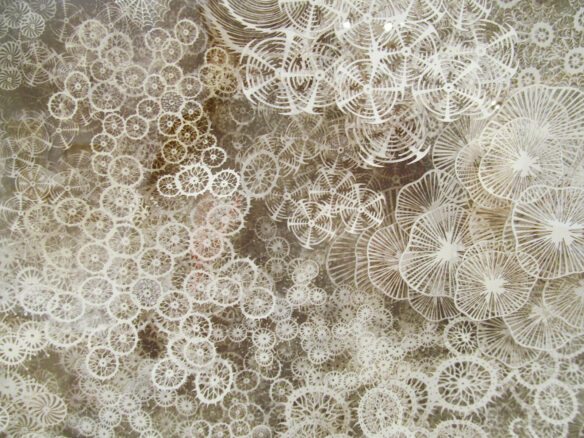
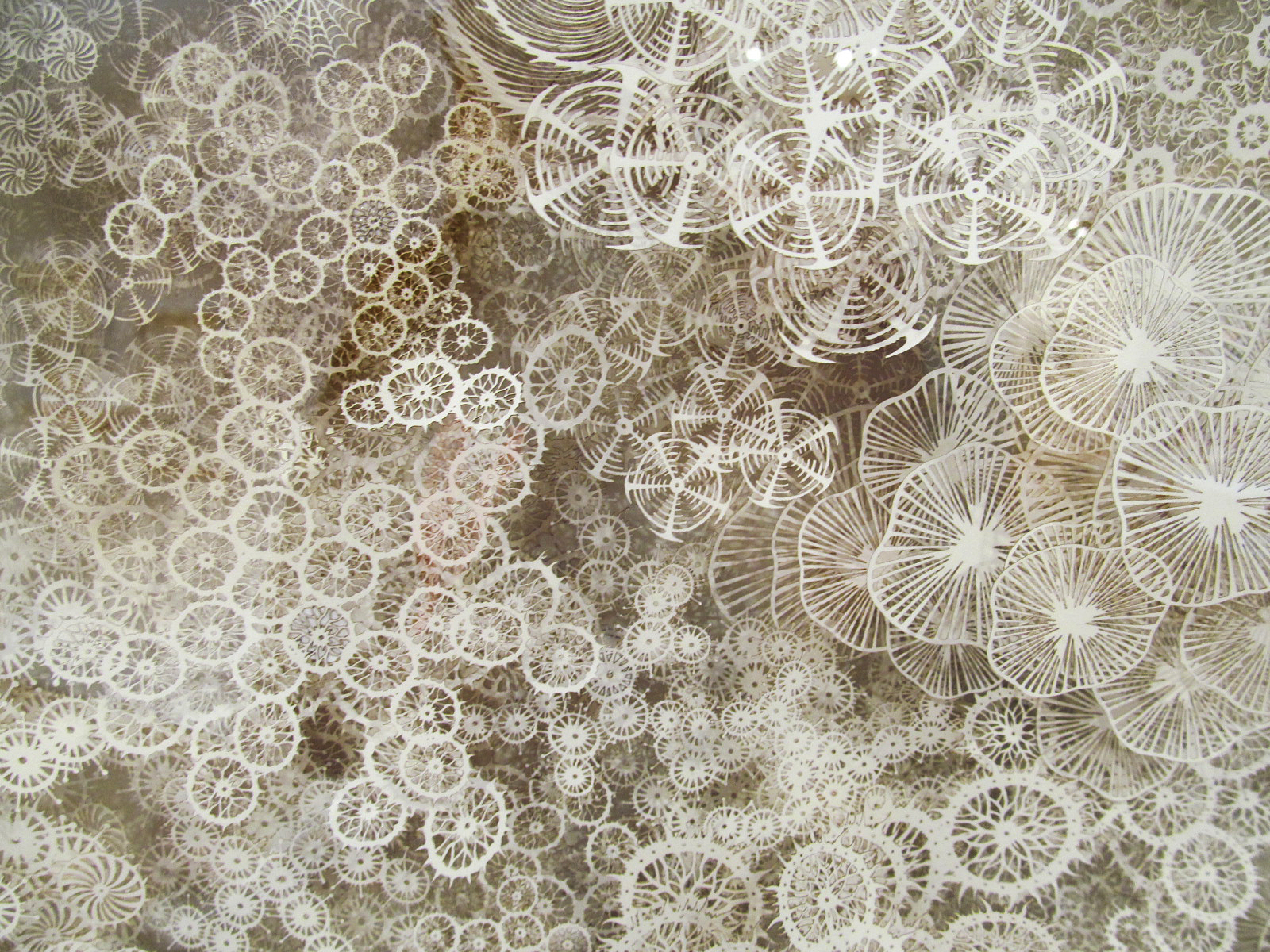
Rogan Brown‘s art resides at the confluence of science fact and science fiction, weaving narratives of scientific discovery and innovation into visually captivating creations…
As a non-scientist, he translates profound scientific paradigms—ranging from our evolving understanding of bacteria to the complexities of quantum physics—into art, aiming to make these esoteric concepts accessible and relatable. Through intricate paper cuttings, Brown transforms a mundane material into something extraordinary, mirroring how scientific advancements reshape our perception of the familiar.
His work explores the theme of science’s limitations against nature’s vast complexity, depicted through overwhelming detail that mirrors the immense data science must decipher. His large hand-cut pieces, created over months, echo the slow processes of growth and decay in nature, while his use of paper, with its fragility and strength, symbolizes the delicate balance of the natural world. By cutting and transforming paper, Brown poetically reconnects it to its origins, much like the scientific endeavor to explore and comprehend the intricate web of life.
One of the primary objectives of your artistic endeavors is stated as the transcription of nature’s grandeur, rather than merely its duplication. Through this process, you aim to induce a state of contemplation and reflection in the viewer who will then be prompted to pause and ponder the very essence of the natural world. What, precisely, do you hope to achieve within the mind of the observer as a result?
As an artist deeply immersed in the intricate beauty of nature, my primary goal is not merely to replicate its forms, but rather, as you suggest, to transcribe its essence into my artwork. I believe that through this process, I can invite viewers into a state of profound contemplation and reflection that is at once pleasurable and meaningful. When someone engages with my pieces, I hope to awaken within them a sense of awe and reverence for the complexity and interconnectedness of the natural world.
I aim to prompt viewers to pause, to take time to open their eyes and truly see and appreciate the intricacies of life that often go unnoticed in the hustle and bustle of daily existence. In the mind of the observer, I aspire to evoke a sense of wonder and curiosity, encouraging them to delve deeper into the mysteries of the universe. Through my art, I seek to spark a dialogue between humanity and nature, fostering a deeper understanding of our place within the broader ecosystem.
Ultimately, I hope that my work serves as a catalyst for introspection and appreciation, inspiring individuals to cherish and protect the wondrous diversity of life on our planet. By instilling a sense of connection and stewardship, I can to contribute to the ongoing dialogue surrounding environmental conservation and sustainability.
The celestial and microscopic realms mirror each other with mathematically precise symmetries. At a closer glance, the parallels between terrestrial forms and the patterns of the universe become apparent. We, as creations with natural bodies possess the psychological gift of being able to transcend the constraints of what hard reality is through imagination. In your view, what facilitates our ability to mentally transcend what seems fundamentally inescapable? Is imagination solely a matter of identifying and subverting natural laws, or is there something possibly spiritual or philosophical about it?
From my perspective as an artist deeply immersed in the exploration of nature’s intricate patterns and forms, I see imagination as a tool and a process that allows us to transcend what may seem fundamentally inescapable in the natural world. While there are certainly scientific principles and mathematical symmetries that govern the universe, our ability to imagine and conceptualize beyond these constraints is what sets us apart as human beings.
Imagination is not solely about identifying and subverting natural laws; it encompasses a broader, more holistic understanding of the world around us. It allows us to perceive connections and patterns that may not be immediately evident, bridging the gap between the celestial and the microscopic realms. Through imagination, we can envision possibilities beyond our current reality, exploring the depths of philosophical and spiritual realms. There is indeed a spiritual and philosophical dimension to imagination. It enables us to ponder existential questions, contemplate the mysteries of the universe, and grapple with concepts such as consciousness and the nature of reality.
Imagination serves as a gateway to realms of thought that transcend the material world, offering us glimpses into the profound interconnectedness of all existence. In essence, imagination is a multifaceted phenomenon that encompasses both scientific inquiry and philosophical contemplation. It allows us to transcend the boundaries of what is known and explore the infinite possibilities that lie beyond, enriching our understanding of ourselves and the world we inhabit…
Current show in New-York : May 16 – December 6
Rogan Brown artworks can be seen as part as the traveling show Iris Van Herpen – Sculpting the senses, at Brooklyn Museum in New-York.