Excerpt:
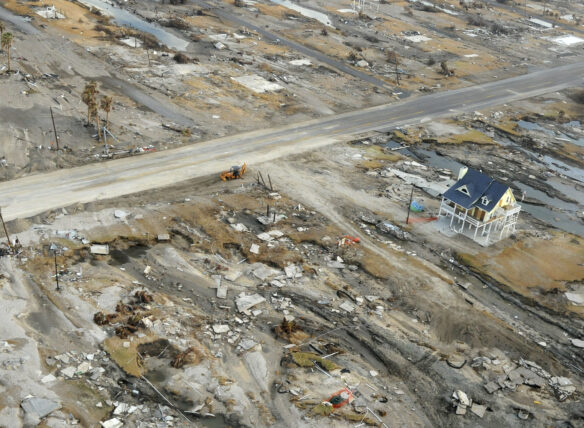
16 oceanfront homes in Buxton and Rodanthe have collapsed into the Atlantic Ocean since mid-September 2025, resulting in widespread debris along the shoreline and prompting an extensive cleanup effort by local and federal stakeholders along the Cape Hatteras National Seashore (CHNS)…
Most of the losses are concentrated along Buxton’s Tower Circle, Cottage Avenue, and Ocean Drive neighborhoods — a section of shoreline that has benefited from federally engineered protection in the past, but has recently lost much of that buffer.
The events in Buxton are not the result of a single failure but of many forces converging at once — persistent erosion, beach engineering timelines, policy hurdles, and limited insurance or funding for demolition. Together, they have created a landscape where even well-intentioned solutions are difficult to finance, approve, or sustain.
Rising losses along the Buxton shoreline
The first house fell on September 16 on Tower Circle Road, and by the end of October, 15 more had followed, including one in Rodanthe. Each collapse prompted temporary beach closures, extended debris-removal operations, and resulted in safety warnings for visitors.
County property records show that nine of the 16 homes were purchased within the past four years, primarily by off-island investors or second-home owners. Their collective purchase price exceeds $5.3 million, averaging roughly $595,000 each.
Nearly all are listed as vacation rentals, reflecting a wider trend: most oceanfront homes on this stretch of Buxton’s beach are not year-round residences but short-term rental investments.
Before the collapse
Once waves reach a house’s septic field or undermines pilings, it becomes officially “threatened.” Dare County and CHNS inspectors notify owners in writing, advising that the structure is unstable and may soon fall. CHNS spokesperson Mike Barber said in an earlier interview that the Seashore has contacted “more than 30 owners of threatened oceanfront structures” in Buxton and Rodanthe since 2023 to encourage relocation or demolition.
If an owner moves forward, they must apply for a free special use permit from the National Park Service (NPS) to bring in demolition equipment or to stage debris. However, the cost of privately contracted demo work — often between $25,000 and $40,000 or more — is borne entirely by the owner.
That financial gap has become one of the central policy frustrations for Outer Banks officials. Neither CHNS nor Dare County has the authority to compel demolition of private property within the Seashore’s boundaries, leaving mitigation largely voluntary.
There’s precedent for this limitation. Roughly a decade ago, local officials in Nags Head attempted to compel homeowners to remove condemned oceanfront dwellings before they became public nuisances. The town lost the legal battle, which ended with a $1.7 million expense to local taxpayers. That history has made officials cautious about pursuing forced removals today.
After the collapse
When a structure falls, CHNS immediately closes nearby beach sections and issues public warnings. Debris can spread quickly, propelled by wind and currents. Fragments from a single Buxton collapse in 2025 were found more than three miles to the north within 48 hours, and the Rodanthe debris field extended for 10 miles or more along the shoreline.
Homeowners are technically responsible for cleanup and are expected to hire contractors. When they do not, or when additional efforts are needed (which is often the case), CHNS takes the lead to protect public safety and wildlife habitat. In recent weeks, Dare County’s debris contractor has also handled materials staged by homeowners near the road, while Park Service personnel and volunteers have removed debris from the shoreline.
Following the September–October collapses, CHNS crews hauled more than 400 truckloads of debris during cleanup, with additional collections continuing for weeks afterward. Items retrieved included wood framing, nails, insulation, carpet, furniture, and septic components. Once large debris is cleared, CHNS staff use sifters and hand tools to remove smaller materials that pose hazards to beachgoers.
In fact, these smaller-debris removal actions were being conducted last week, before five more homes collapsed on Tuesday, inundating the shoreline with a new wave of larger materials.
Federal shutdown adds uncertainty
Following Tuesday’s collapses, cleanup operations this time will continue under the shadow of an ongoing federal government shutdown. CHNS staff are working, but may be doing so without pay. A prolonged funding lapse could slow debris-removal efforts if staff availability or equipment support changes.
As of late October, CHNS had not announced any operational reductions for emergency cleanups, but a continued shutdown could affect longer-term recovery work…