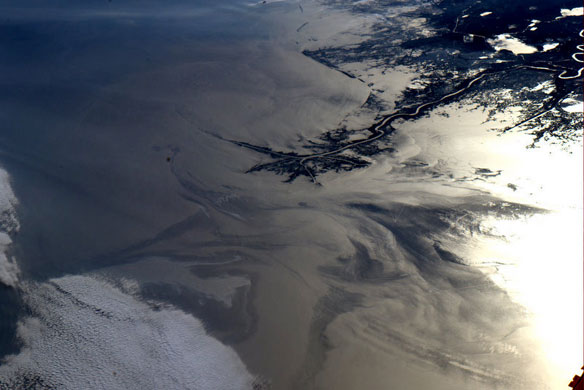
Commission hears: 50 Percent of BP Spilled Oil Remains in Gulf

Posted In Gulf Oil Catastrophe, News
Sep
28

Sediments Oil
“This enormous oil spill affects hundreds of miles of beaches in the Gulf of Mexico,” Huettel said. “We can remove the oil from the beach surface, but oil is also carried deeper into the sand, and we need to understand what happens to that oil. Preventing groundwater contamination is crucial not only to Gulf Coast residents but also to coastal management”
Photo Source: Markus Huettel, Florida State University.

By Alex Ogle, The Associated Press.

Over half the oil released from a busted BP well remains in the Gulf of Mexico, a presidential panel has been told, contrary to government claims, as the US pointman lamented a “dysfunctional” response to the disaster.

Interior Secretary Ken Salazar meanwhile told the bipartisan commission the spill had bolstered a drive to reform federal regulations for offshore drilling, promising that lessons were learned with a moratorium still in place.

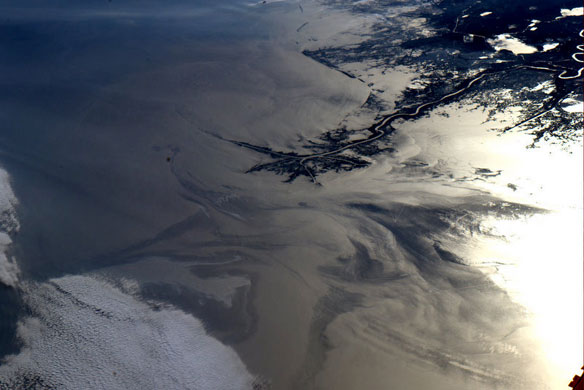
In an ominous sign for residents of states on the Gulf of Mexico, however, oceanographer Ian MacDonald said that while much of the oil was dispersed, evaporated or removed by burning and skimming, “the remaining fraction, over 50 percent of the total discharge , is a highly durable material that resists further dissipation.”

The assessment implied some 2.5 million barrels of oil, or 105 million gallons, was still embedded in the fragile ecosystem, out of the estimated 4.9 million barrels that gushed into the Gulf during the 87 days before the well was capped.

“Much of it is now buried in marine and coastal sediments,” MacDonald warned, adding there was “scant evidence for bacterial degradation of this material prior to burial.”

Sediments Oil
Heavily oiled sediments from a barrier island off the coast of Louisiana. (Photo courtesy of Joel E.)
Liquid oil (in the form of an oil sheen, or small dispersed droplets) can penetrate many feet deep into the permeable beach sand. Oil-filled water that washes up on the beach filters through the porous sediment and carries the oil with it into the sand, “In addition, the water-level drop between high and low tide causes a water-level drop within the beach sediment that can transport oil that has penetrated into the beach into even deeper sediment layers.”
Markus Huettel, Florida State University.

His analysis presented to the panel stood in contrast to a more encouraging official report in early August that claimed some 75 percent of the oil spilled from the well had disappeared.

Retired coast guard admiral Thad Allen, earlier acknowledged how confusion, from both the US public and local public officials, over who was in charge of the response meant “procedures that worked terrific for the last 20 years became dysfunctional.”

Efforts to prevent oil from washing onto the fragile Gulf Coast, cap the flow of crude and clean it off the shoreline were all impacted by the confusion, Allen said.

Billy Nungesser, the outspoken president of Plaquemines Parish in southern Louisiana, told the panel the problem persists months after the oil has stopped flowing: “This late in the day, I still can’t tell you who’s in charge.”

Known for passionate tirades against the government and BP as the spill impacted the local economy and coastline, the rotund Nungesser appeared a world away from the muggy swamp lands of his home district when he spoke forcibly to the panel in a luxury Washington hotel conference room.

“I’m still angry,” he reminded the commission, saying the fight for survival in his community remains, with residents struggling to get back on their feet.

Hundreds of miles of coastline from Texas to Florida were sullied by the devastating spill, in the wake of the April 20 explosion that crippled BP’s Deepwater Horizon drilling rig off Louisiana, killing wildlife and choking local communities that rely on industries such as tourism and fishing.

The controversial use of chemical dispersants in a bid to break down or suppress the oil from the reaching the surface prompted intense internal discussion, US Coast Guard Rear Admiral Mary Landry told the panel.

While US officials “absolutely felt there could be a reduction” in their use, it was decided in the early weeks of the spill there was a greater need to mitigate the coastal impact and amount of oil at the Deepwater Horizon site.

“Over time, we met that goal of reducing dispersants,” she said.

When authorities managed to cap the well after more than 12 weeks, however, some 1.8 million gallons of of the chemicals had been used.

Dispersants were deemed “generally less toxic than oil… and has been known to biodegrade over days and weeks, much quicker than the oil,” Environmental Protection Agency Administrator Lisa Jackson said.

The long-term effects of their use and the massive quantities in which they were employed still “warrant caution,” Jackson warned the commission.

Earlier this month US officials declared the broken well to be finally capped, but BP still faces a long uphill battle to clean up the Gulf, along with a litany of lawsuits, billions of dollars in fines, and shareholders angered by the firm’s instability after its share price more than halved.

BP has pledged to continue “remedying the harm that the spill caused to the Gulf of Mexico, the Gulf Coast environment and to the livelihoods of the people across the region.”

Original Article

Science News Article

Related Posts

Tags: ,

Post comment

Resources

Federal

  • Deep Water Horizon Response is the official site of the incident in conjunction with BP, DOI, NPS, USGS, CDC, USFWS, NOAA and other branches of the US government (collectively called Unified Command). Information, including the latest news, photos, area plans, and volunteer information.
  • NOAA is a government program that uses science and research to protect life, property and natural resources. This NOAA site provides maps of the spill and related statistics, including a trajectory forecast map for the oil spill.
  • The Environmental Protection Agency provides data on Air, Land, and Water pollutants including sampling maps and contaminant levels.

Louisiana

  • Volunteer Louisiana is the official site for the State of Louisiana to get involved in the spill response.
  • The Louisiana Department of Wildlife and Fisheries provides maps of closures to fishing areas in LA.
  • The Louisiana Emergency Office has made Google Earth files of the spill available to the public here http://gohsep.la.gov/oilspill.aspx and also has current information on general closures of waterways, photos, and reports.
  • The Audubon Nature Institute site provides a number for citizens to call if turtles, manatees, dolphins, or other animals are in distress
  • The Oiled Wildlife Care Network is a CA based non-profit is advising folks in the Gulf of Mexico on best practices and provide resources on how people can help.
  • The Coalition to Restore Coastal Louisiana is a non-profit organization who strive to protect and restore coastal Louisiana. Volunteers are needed for numerous actions including: monitoring, oiled wildlife recovery, boat driving, or simple monetary donations.
  • The Greater New Orleans Foundation is a philanthropic organization in Louisiana and the surrounding region that joins with other non-profit, foundations and community and government officials to address the needs of the community. The Foundation has opened the Gulf Coast Oil Spill Fund.
  • The Louisiana Bucket Brigade is an environmental health and justice organization working with communities near oil refineries and chemical plants. They aid residents in these regions to reduce pollution and protect public health. The Brigade has formed an incident map where you can report observed signs of oil.

Alabama

  • The Alabama Coastal Foundation is an education based organization whose mission is to project the quality of Alabama’s coastal resources. They are currently training volunteers to help directly with the spill response.
  • The site by the Alabama Governor’s Office of Faith-Based and Community Initiatives gives basic phone numbers.
  • The Mobile Bay National Estuary Program is an organization funded by the EPA fighting the environmental challenged facing Mobile Bay. This site gives e-mail addresses and phone numbers to help and provides basic information.
  • The Mobile Bay Keeper is a group of citizens who are interested in preserving the Mobile Bay watershed as well as protecting the health of the individuals and environment in the Bay. Check out the latest information about the spill and learn how to become a member and donate to the cause.

Mississippi

Florida

  • The Florida Department of Environmental Protection is the lead agency in FL and this website provides the most thorough information in the state.
  • Volunteer Florida, the website of the Governor’s Commission on Volunteerism and Community Service and the State Emergency Response Team, lists volunteer opportunities by county.
  • The Escambia County site provides summary points of actions taken by BP and FL with a focus on the County.
  • The Pinellas County site is a concise list of related local websites and numbers for information.
  • The Gulf County site has current news on the spill as it relates to the county
  • Volunteer directly with the largest wild bird hospital in the United States, the Suncoast Seabird Sanctuary.

Organizations and other networks

  • American Birding Association
  • Audubon is a global leader in protecting birds and other wildlife and their habitats. They are partnering with other organizations.
  • The Sierra Club is a grassroots environmental organization that works to protect communities, wild places, and the planet. Updates on the oil spill, as well as volunteer and donation information.
  • The Nature Conservancy is a conservation organization with a mission to preserve and protect ecologically significant lands and waters for nature and people. Learn more about the oil spill and how to help out at http://www.nature.org/wherewework/northamerica/states/alabama/features/oilspill.html and check out their blog.
  • Sea Grant is nationwide network (administered through NOAA) of 32 university-based programs that work with coastal communities on environmental stewardship and the responsible use of our coasts. The Gulf of Mexico Sea Grant Programs provides resources to educators with research that may be impacted by the spill.
  • The National Wildlife Federation is America’s largest conservation organization whose mission is to protect and restore wildlife habitat, confront global warming and connect with nature. Get the latest information on the oil spill crisis and how to help.
  • The mission of Tri-State Bird Rescue and Research is to provide rehabilitation of injured, orphaned, and oiled native wild birds to return to their natural environment. Donate to their research.
  • Green Peace is an international organization that strives to save the planet from environmental threats such as global warming, destruction of forests and deterioration of the oceans. Follow their blog and learn how to take action.
  • Global Green USA is an international environmental non-profit organization with an office in New Orleans that strives to fight global climate change, eliminate weapons of mass destruction and create clean, safe drinking water for all. Follow their blog and get involved.
  • Matter of Trust is a non-profit organization focused on materializing sustainable systems by mimicking Mother Nature as well as concentrating on manmade surplus, natural surplus and eco-educational programs. Learn very simple ways to help the oil spill crisis.
  • The official Facebook page of Unified Command.
  • BP Gulf of Mexico response.