
Yurok indians seek land for a tribal park on the North Pacific Coast

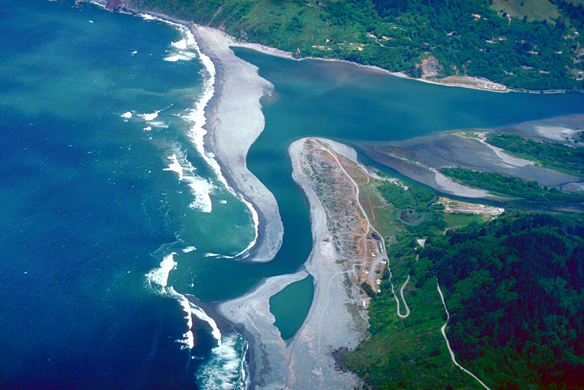
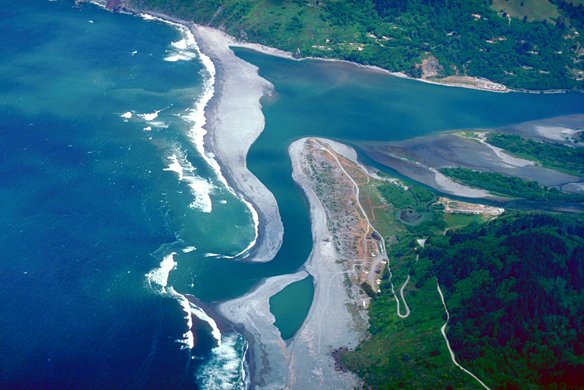
Klamath Rivermouth, Del Norte County, Northern California. Photo Source: US Corps of Engineers.
The Klamath River rises in the southeastern part of the U.S. state of Oregon, and flows about 263 miles (423 km) southwest through northern California, cutting through the southern Cascade Range to empty into the Pacific Ocean.
The Yurok were a sedentary coastal hunter/gatherer Pacific Coast Indian nation that relied heavily on fishing. They occupied the valley of the lower Klamath River and the neighboring coast. The Yurok, whose name means “downriver people” in the neighboring Karok language, are Native Americans whose ancestors, by some estimates, have lived for at least 10,000 years near the Pacific Ocean coast of Northern California.
The Yurok settled at the mouth of the Klamath River and the Pacific coast, and nowadays many live along the lower 36 miles of the Klamath River and the California coast from Wilson Creek to Trinidad Bay. Yurok Reservation’s lands currently extend from one mile on each side from the mouth of the Klamath River and upriver for a distance of 44 miles.
The Redwood National and State Parks (RNSP) are located along the coast of northern California. Comprising Redwood National Park (created 1968) and California’s Del Norte Coast, Jedediah Smith, and Prairie Creek Redwoods State Parks (dating from the 1920s), the combined RNSP contain 133,000 acres (540 km2). Located entirely within Del Norte and Humboldt Counties, the four parks, together, protect 45% of all remaining Coastal Redwood (Sequoia sempervirens) old-growth forests, totaling at least 38,982 acres (157.75 km2). Before commercial logging and clearing began by the 1850′s, this massive tree occurred naturally in an estimated 2.1 million acres along much of coastal California (excluding southern California where rainfall is not abundant enough) and the southwestern corner of coastal Oregon within the United States.

“When the extraction of gold in the river’s tributaries sent slurries of mud and tailings downstream, the native peoples got their first exposure to industrial pollution, and to the notion that an economy could be enriched by destroying its resources, instead of husbanding them.” Russ Rymer; author of Genie: A Scientific Tragedy and American Beach—A Saga of Race, Wealth, and Memory
Yurok tribe indians seek land for a tribal park on the North Pacific Coast
By Julie Cart, Los Angeles Times
California’s largest tribe has set its sights on obtaining a 1,200-acre slice of Redwood National Park, part of an ambitious plan to cobble together a new tribal park that could add eco-lodges, gift shops and water taxis into backcountry along the Klamath River.
The Yurok Tribe envisions that its park would be managed as part of the chain of national and state parks that necklace the Redwood Coast from Mendocino County to the Oregon border, some of the most spectacular and contested landscapes in California.
The Yurok have lived along this rugged coast for centuries, although the tribe has lost much of its land base since its reservation was established in 1855. Tribal leaders see their aspirations to gain land as nothing less than essential nation-building, and are seeking congressional approval for the transfer of thousands of acres of public land from the park service, forest service and the Bureau of Land Management. The tribe also wants a boundary expansion.
Although Yurok officials emphasize that all park projects will adhere to the highest environmental and cultural standards, they have been reluctant to provide much detail about how the system they dub the “Redwood National State and Yurok Tribal Park” might operate. The current arrangement between the state and national parks that share some responsibilities is itself unusual; there is no precedent for a similar agreement including a tribe.

Klamath Rivermouth, onto Pacific Ocean. “Fishing with the Yurok,” Photo Source: The New York Times
Among those who want more information is Steve Chaney, superintendent of Redwood National Park. He maintains that it could be difficult to integrate federal and state park management policies with the Yurok’s vision, which the tribe has yet to reveal publicly.
“At this point, we don’t have a huge amount of information to react to, no idea what they plan,” Cheney said. Pointing to an office shelf groaning with multi-volume federal land management guidelines, he added, “We’ve got a litany of things that tell me how resources are managed. Co-management has been talked about a lot but not defined. It’s a buzz word.”
The Yurok reservation’s boundaries were reestablished in 1988 through the Hoopa-Yurok Settlement Act and overlap with the national park at the mouth of the Klamath River. The overlap, a slice of foggy coastal land, is what proposed legislation would transfer to the tribe. The transfer was originally included in the 1988 Act but was eventually taken out by senators who called the proposal too controversial.

Redwood Beach. Photo Source: wikimedia
The tribe is asking Rep. Mike Thompson (D-St. Helena) to introduce legislation that would transfer 1,200 acres of a woody knob of Redwood Park and 1,200 acres of redwood stands in the Six Rivers National Forest to the tribe. The Yurok are also seeking control of Redding Rock, an offshore sea stack that is part of the California Coastal National Monument.

Coastal Redwood Trees
The Yurok’s master plan would create a national scenic highway and a national marine sanctuary. But it is the national park land from Redwood that is creating the most concern. For this area, at least, the Yurok are willing to spell out guidelines for their proposed tribal park.
The National Park Service transfer lands “will be managed in accordance with NPS policies,” said tribal chairman Troy Fletcher. “For land that we purchase ourselves, we will manage as we see fit. Why is it for anyone else to define?”
Fletcher, a tireless campaigner for the Yurok, said the tribe’s unorthodox gambit to join with the state and national parks is making waves because it’s “blurring the lines. We are into cutting-edge stuff. If you read the general management plan for the park, their goal is to manage the land the way it was 150 years ago. Guess who was managing the land 150 years ago.”
Thompson has not signed off on the wording of the bill, saying in a statement, “The Yurok tribe has been great to work with but there remains more work to do before any legislation will be ready to be introduced.”
An early draft of the proposed legislation authorized a $50-million allocation to the Yurok to purchase 47,000 acres of commercial timber land. The tribe later withdrew the provision, saying that the appropriation was politically untenable and that the Yurok leadership never signed off on it.
But the tribe has other resources to which it can turn. The Yurok’s seven-year land-acquisition project is driven by a sophisticated campaign that has yielded million of dollars in loans and grants from federal, state and private sources. The Western Rivers Conservancy is helping the Yurok raise the estimated $73 million required to purchase the timber land. Earlier this month the state water board awarded the tribe an $18.7 million loan to purchase a portion of the timber property.

Klamath Rivermouth, onto Pacific Ocean. “Fishing with the Yurok,” Photo Source: The New York Times
Some ideas of how a tribal park might work were set out by the tribe’s well-connected consultant, Destry Jarvis, who had a long park service career. He is the brother of Jon Jarvis, the service’s national director. Destry Jarvis’ 2005 tribal park plan envisioned an array of possible activities such as water taxis and Yurok-guided trail hikes. The unspoiled Blue Creek watershed is a critical component of the park, according to the plan, and is part of the yet-to-be purchased commercial timber property.
Yurok leaders met with the National Park Service’s regional director and representatives of conservation groups last week, but those organizations have been surprisingly mum on the topic. The venerable Save the Redwoods League, which was among the groups that waged a 60-year battle to protect the state’s big trees, declined to comment on the Yurok’s plans.
Ron Sundergill, senior director for the National Parks Conservation Assn., a parks advocacy group, said that although he’d like to see more details about the Yurok’s vision for a tribal park before the group can endorse the legislation, he is confident of the tribe’s direction.
“I think their environmental ethic is quite strong,” he said. ” I’m hopeful that it will be what really drives them.”

Pacific Ocean. “Fishing with the Yurok,” Photo Source: The New York Times
Conservation groups spent decades fighting to preserve the state’s redwood forests against unrestrained timber harvesting and successfully campaigned to set aside stands of the tall trees in a swath of state and national parks that follow California’s far northern coast. The remote but beloved park lands have an international following.
To Janine Blaeloch, director of Western Lands Project, which monitors the privatization of federal land, the moral issue of restitution for tribal lands taken away factors into any decision to give the Yurok the Redwood property. But, she said, “on the other hand, if what you care about is keeping public land public, this takes that away. I don’t like to see that muddled. You and I and everyone else gets to have a say in how these lands are managed.
“Public lands is an ideal that is under constant attack and constantly has to be defended,” she added. “The thing I would worry about is this is the first shoe dropping, and what happens next? It could definitely set a precedent.”

“Fishing with the Yurok,” Photo Source: The New York Times
New York Times, Struggling Tribe, Dark Side to a Windfall
The Yurok Indians, the largest tribe in California and one of the poorest.



Joseph P. Paoluccio AIA PE says:
I am not in favor of transferring public lands to any special interest group for any purpose. The Klamath River has been open to the public for many years and offers great opportunity for quality recreation. What we don’t need is another commercial venture that profits one special group at the expense of all Californians. I have fly fished the Klamath for over 50 years and have enjoyed working with the local guides and others who supply services including restaurants and motels. Please leave the Klamath River alone.
Joseph P. Paoluccio AIA PE