Beach Renourishment Projects in Doubt

A $35 million plan to widen an eroded stretch of beach at Sand Key has been postponed, bringing worries that a big storm could be dangerous to the coastline.
Drew Harwell, The St Petersburg Times
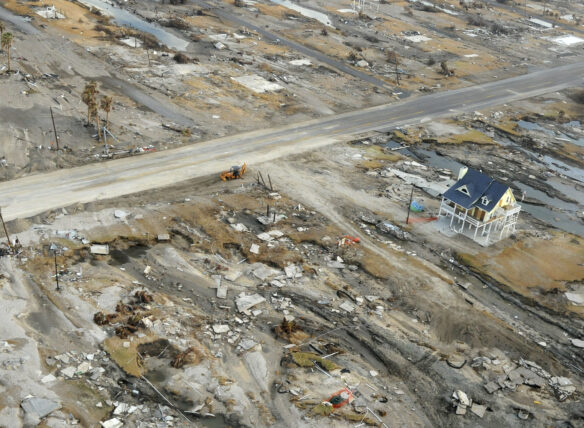
On a narrow stretch of Sand Key near the Belleair Beach Club, the beach has eroded from months of rushing waves. Tides eat away at the coast, sweeping sand back into the gulf. Unstopped by the shore, water rolls to the seawall, 20 feet from condominiums.
“It puts the buildings in an awkward position out there,” said Sand Key Civic Association president Gene Gillespie. “If you have no beach at all, and a storm comes in, you can just imagine what happens.”
Planners designed a $35 million project to widen eroded beaches between Clearwater Pass and North Redington Beach this summer. But a recent bureaucratic stalemate over an offshore reef has stalled the project until next year, leaving millions of dollars for the project at risk of reappropriation.
The impasse is only the latest obstacle to beach renourishment, the complicated, expensive and unending practice in which dwindling coastlines are rebuilt with tons of pumped-in sand.
Beach projects planned years in advance were shrouded with uncertainty last month after Gov. Rick Scott’s proposed budget zeroed out next year’s renourishment money.
Last year, when officials requested $80 million for beach renourishment, the state Legislature paid out $15 million. This year, with more than $100 million in requests, Scott proposed the state pay nothing.
That sudden reversal could endanger future renourishment projects at Honeymoon Island, Upham Beach and Treasure Island, whose federal and state funding could potentially dry up.
But it also puts at risk projects like the Sand Key renourishment, where money already set aside could be pulled for other use.
Sand Key, the 14-mile barrier island curving from John’s Pass to Clearwater Pass, is stacked with condo towers, hotels and homes susceptible to encroaching tides. State officials classify Sand Key as a high priority for beach repair work.
But planning the next renourishment, typically scheduled every four years, has proved a challenge.
Congress has yet to pay the last half of its expected $20 million contribution toward the project, said Pinellas County coastal manager Andy Squires.
The state Department of Environmental Protection and the U.S. Army Corps of Engineers disagree on how to monitor the hard bottom reefs in the shallows off Sand Key, stalling a permit needed to receive another $4 million in state funds.
The permitting delay is risky for the money, which the state could still put somewhere else. Asked how much time the renourishment had before the money was reappropriated, Squires said, “I don’t want to ask.”
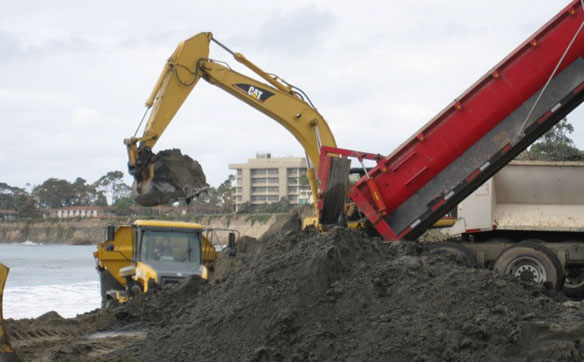
Much of the renourishment, draft plans show, would start at the barrier island’s northern tip. Crews would spread half a million cubic yards of sand over 2 miles between Sand Key Park and Belleair Beach, and another 300,000 cubic yards along 7 miles of Indian Rocks Beach, Indian Shores and North Redington Beach.
At Honeymoon Island, Florida’s most popular state park, another project faces a similarly uncertain fate. Officials worry a $6 million plan to renourish the eroded beach and install rock jetties, scheduled for the end of next year, could go unfunded.
Planners suggested they could save money by shifting the beach farther inland, surrendering parts of a concrete parking lot to the tide. Retreating would be cheaper than fighting the tide with sand, Squires said.
“It could be a unique situation,” he said, “where the state doesn’t have enough money to nourish its own state park.”
Wind and water erosion can scatter a beach over time, pulling sand into the tide and posing dangers to a developed coastline. Recent winters marked by cold fronts and sweeping winds have been especially damaging.
To reverse the wear and tear, renourishment crews dredge slurries of sand and saltwater from large sand bars off the coast, pump them inland and drive bulldozers across the beach to smooth the sand into shape.
The work buttresses the coastline against storms and restores habitats for shorebirds and sea turtles. It also keeps the beach pretty. A 2003 study by Florida Atlantic University said that each state dollar spent protecting public beaches from erosion equaled a potential $8 tax gain from tourists and local beachgoers.
Bordered by 825 miles of sandy shoreline, Florida tops the nation in federally funded beach renourishment. Much of the 40 miles of Pinellas barrier islands, stretching from Anclote Key to the entrance of Tampa Bay, is considered critically eroded and in need of regular repair.