Excerpt:
“Most countries don’t grow 10 km or 20 km [6-12 mi] every single decade, but Singapore does,” said William Jamieson, a postdoctoral research associate at Royal Holloway, University of London, who works on the global sand crisis.
Between 1965 and 2025, the country’s total land area increased by 28%.
Authorities in Cambodia’s Koh Kong province say they’ve approved a sand mining operation exporting to Singapore, despite an export ban imposed by national authorities a decade ago after large-scale dredging was found to be damaging riverine and coastal ecosystems.
The dredging is occurring in an area of the Trapeang Rung River that falls within the boundaries of Tatai Wildlife Sanctuary and Botum Sakor National Park.
Khlem Yonviseth, director of the Koh Kong provincial mining department, told Mongabay that the 2017 sand export ban had been lifted, and that his office had given a permit to the dredging operation and approved the exports.
Yonviseth did not respond to a request to provide documentation of the ban being lifted. Mongabay was unable to locate any official announcement regarding the ban, and the relevant national agencies did not respond to requests for comment.
Yonsiveth’s comments come after activist group Mother Nature Cambodia exposed the dredging operation in a video published July 14. In a subsequent video, published Aug. 8, the group tracked multiple cargo ships heading from Koh Kong Krao, Cambodia’s largest island, to Singapore’s Tuas Port.
“How many more tons of Cambodian sand will be lost?” asks Lisa Mean, an activist with Mother Nature Cambodia, in the latest video.
Analysis by Mongabay confirms that four of the ships identified by the group traveled to the Tuas Port, where a state-backed land reclamation project is currently underway.
Mongabay has also found that the company Yonviseth said had been given a dredging license, Catalyst Marine and Resources, is linked to Starhigh Asia Pacific, a Singaporean company that is active in sand mining operations across the region.
Using automatic identification system (AIS) data, a tracking system commonly used by large vessels to improve maritime safety, Mongabay identified the ship filmed by activists as the Maltese-flagged Densa Dolphin. It’s one of four ships that made the same journey from Cambodia to a reclamation site at the state-developed Tuas Port in Singapore between June 1 and July 26, 2026. The others are the Liberian-flagged Star Halifax, Panama-flagged HPC Atlantic, and Marshall Islands-flagged Krait.
All four ships are between 185 and 199 meters (607 and 653 feet) in length and classified as bulk carriers, a type of large merchant ship used to transport a variety of materials, including sand.
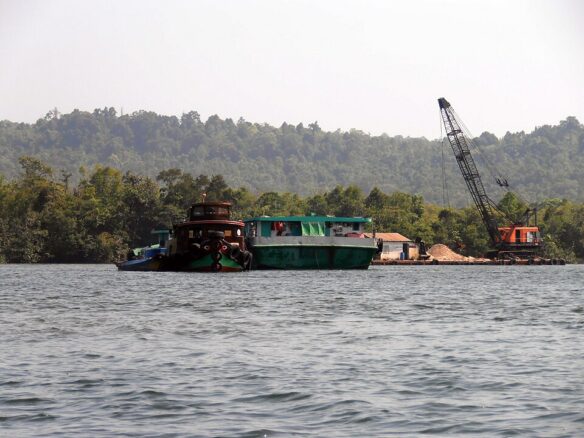
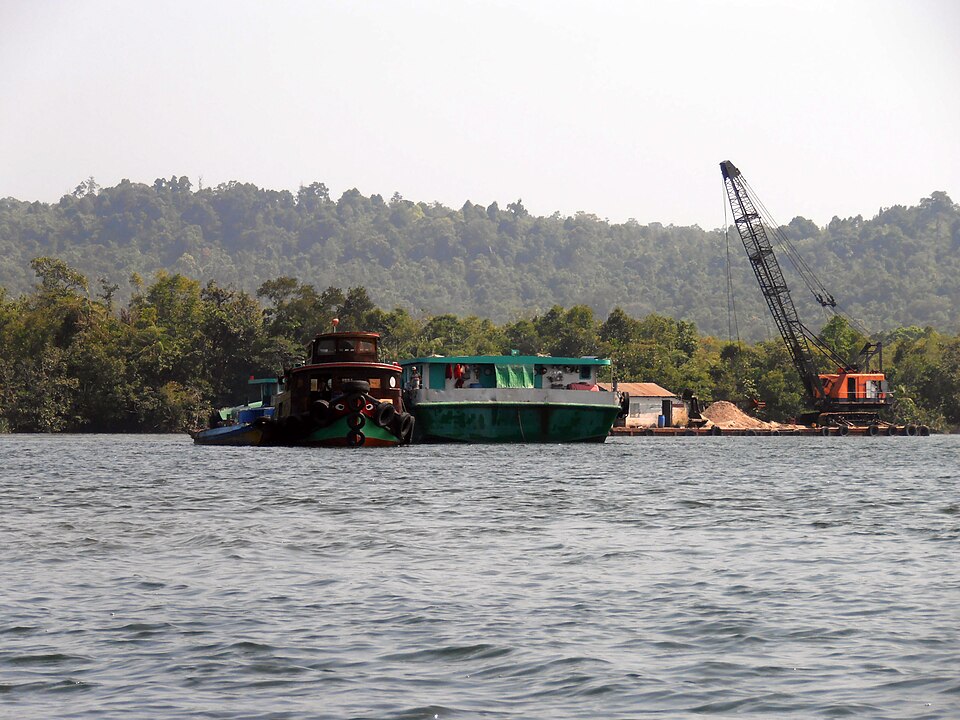
Mongabay was unable to confirm the source of the sand allegedly being delivered to the Densa Dolphin. However, photographs taken by Mother Nature Cambodia on July 2, 2026, and independently verified by Mongabay show sand mining barges operating along a stretch of the Trapeang Rung River approximately 25 kilometers (15 miles) from where the bulk carriers were anchored off Koh Kong Krao.
The activists’ photographs appear to show barges bearing the logo of Catalyst Marine and Resources, a company that’s been registered in Cambodia since December 2024.
Yonviseth, from the provincial mining department, told Mongabay that the government issued Catalyst a license to dredge on the Trapeang Rung in 2025.
Magdalena Smigaj, an Earth observation data scientist and co-author of a 2023 paper that used machine learning and satellite imagery to monitor vessel traffic on the Mekong River, conducted an independent analysis of radar imagery on the Trapeang Rung between January 2020 and July 2026. Smigaj’s analysis found vessels have been consistently active along the stretch of the river photographed by Mother Nature Cambodia since late April 2026, around the same time provincial officials attended a public event announcing the launch of Catalyst’s operations to export sand from Trapeang Rung commune to Singapore.
The stretch of the river being dredged falls within the boundaries of both Tatai Wildlife Sanctuary and Botum Sakor National Park, according to official government maps of those areas. Both are part of a network of protected areas spanning the Cardamom Mountains, one of Cambodia’s best-preserved forests and a biodiversity hotspot.
The Trapeang Rung River is home to the endangered hairy-nosed otter (Lutra sumatrana), one of the rarest and least-understood otter species in the world, and flows into one of the largest mangrove forests in mainland Southeast Asia.
Yonviseth told Mongabay that Catalyst’s dredging proposal was studied by the relevant ministries and received support from local authorities and communities.
Both the Ministry of Environment and the Ministry of Mines and Energy did not respond to multiple requests to comment.
Yonviseth told Mongabay that sand exports to Singapore were once again underway and had “brought many benefits to the state.”
This resumption will “further strengthen bilateral relations between the two governments,” Yonviseth said via the Telegram messaging application. “Sand extraction companies pay royalties, contribute to local community development funds, and pay customs duties and profit taxes…”