Gulf oil spill poses unique health challenges

By Caitlin Stier, NewScientist.
Last week public health experts convened in New Orleans, Louisiana, to tackle unanswered questions about the health effects of the Deepwater Horizon oil spill in the Gulf of Mexico. After the workshop, hosted by the Institute of Medicine, a non-profit organisation within the US National Academies in Washington DC, what do we now know about the health risks?
What are the immediate health hazards of the oil spill?
Exposure to oil can make you sick, but research shows these effects fade over time and are generally reversible. Fumes can irritate the eyes and throat or spur headache, nausea, and flu-like symptoms. Inhaling the dispersants that are being used to get rid of the oil can make you cough as well as cause throat and eye irritation.
Skin contact with oil can cause redness, swelling or rash on the skin. Beach-goers should not swim in areas affected by the spill and avoid touching the oil or spill-affected water.
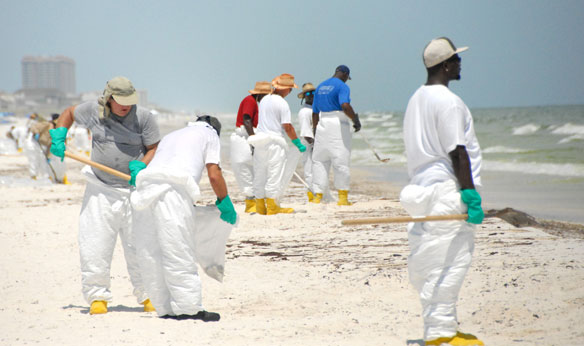
As temperatures soar along the Gulf coast, heatstroke is also a major concern for clean-up workers – particularly those working outside who are not accustomed to the area’s oppressive temperatures.
What components of the oil are dangerous?
Crude oil contains a number of compounds that are carcinogenic and can alter a person’s DNA. It has a complex chemical profile that constantly evolves as it ages and moves from the deep sea to the shoreline.
“Fresh” oil contains volatile organic compounds such as the carcinogen benzene, which quickly evaporate from the ocean surface. Workers close to the site of the leak could be exposed to these toxins, which at sufficiently high concentrations could be hazardous.
Who is most at risk?
Everyone exposed to the oil is at risk, but there is particularly concern about clean-up workers, especially volunteers, who may have inadequate training. Training and ongoing supervision and reinforcement could help protect such workers, so their rapid recruitment could increase the number who become ill.
According to a report by Propublica, a non-profit investigative news provider based in New York, by 17 June 307 workers had reported illness – more than triple the amount previously reported by BP and the Unified Command, an organisation established to manage response operations for the oil spill, up to 10 June. The rise is due to an increase in workers and a backlog in recording incidents, according to safety officials.
Children are more at risk than adults because their bodies detoxify chemicals less efficiently. Being shorter than adults and therefore nearer the ground, they may also be more likely to breathe in heavier-than-air gas pollution.
Are there any long-term risks?
Little is known about these, because few studies have examined the chronic effects of oil exposure. Blanca Laffon, a public health researcher at the University of Coruña in Spain, has observed DNA changes in people exposed to the 2002 Prestige oil spill off the Galician coast. Her team is currently analysing data from last year to see if these changes persist. Such DNA damage could increase a risk of cancer, she explains, much like exposure to pollution or cigarette smoke.
The Exxon Valdez spill in Alaska showed the far-reaching effects on mental health that oil spills can cause in close-knit coastal communities. Increases in domestic violence, depression and drug abuse are all dangers to Gulf communities that have already endured the devastation of hurricanes Katrina and Rita, and the current economic downturn.
The lives of Gulf coast residents are inextricably tied to the water. The oil could do lasting damage to the environment and as a result the livelihoods of residents who depend on it.
Irwin Redlener of the National Commission on Children and Disasters in Washington DC called this burden a toxic stress on the lives of children. “This is way worse than Katrina,” Redlener explained, quoting a 15-year-old local resident: “With the oil spill, we live with uncertainty and most of us are afraid that this place we love will not come back. It will mean the end of our way of life. I don’t know what we’ll do – or how we’ll survive.”
What new health challenges does this spill pose?
This spill is unprecedented in scope and is affecting a region battered by previous disasters. Pre-existing health problems, such as limited access to healthcare and poverty, further complicate this picture. Compared with the rest of the nation, the area already ranks near the bottom in statistics of health outcomes.
Unlike oil spills that have been linked to a single event on a tanker, the Gulf oil spill is continuing. As Paul Lioy, an expert on the aftermath of the 9/11 attacks in public health, explained, every day is “day zero” in terms of controlling exposure.
The ‘Black Tides’ Of Galicia Blanca Laffon, DNA Research, excerpt in Libertas Academica
Blanca Laffon and her colleagues at the University of A Coruna in Spain, research on oil exposure and DNA effects, following the 2002 wreck of the tanker Prestige.
How Will The Gulf Oil Spill Affect Human Health?
by Richard Knox.
Medical researchers have met on June 23rd, in New Orleans to discuss the health effects of the ongoing oil spill in the Gulf of Mexico. But most of the discussion is about what isn’t known.
The workshop was pulled together in a matter of days by the Institute of Medicine, a prestigious independent body chartered by Congress. Health and Human Services Secretary Kathleen Sebelius asked for the review.
Even though oil spills are fairly common, scientists at the two-day workshop say there’s surprisingly little research on how they affect human health.
Since the 1960s, one researcher notes, there have been more than 30 major oil spills, nearly all of them involving shipwrecked tankers. But only about a quarter of them have been studied for toxic effects on humans. And the studies that have been done are often small and without comparison between groups of oil-exposed and unexposed people. In addition, none has so far looked at long-term consequences of exposure, such as cancer incidence.
At the end of a long day of questions and answers on what’s known about the effects of oil spills on humans, activist John Hosey pretty much summed up the situation.
“The answers that people are getting are much like the oil coming out of the floor of the ocean,” Hosey told the assembled scientists. “There’s a lot of it coming up, but none of it’s worth very much.” Hosey is a clergyman with the Mississippi Interfaith Disaster Task Force.
Concern About Long-Term Problems
None of the distinguished researchers in the audience disagreed with his assessment.
That doesn’t mean there’s consensus on what evidence there is. Dr. Scott Barnhart of the University of Washington is on the side that doubts there’s much reason to worry.
It’s true, Barnhart says, that cleanup workers exposed to crude oil often suffer acute effects, stinging eyes, rashes, nausea, dizziness, headaches, coughs and other respiratory symptoms.
But Barnhart is not unduly concerned. “Any of these effects I don’t think we would expect to be permanent,” he says. “We would expect these to be reversible.”
Barnhart also says there’s no convincing evidence that people exposed to crude oil have more serious long-term problems, such as cancer.
“We should not have workers, volunteers, anybody exposed to significant quantities of crude oil,” he says. “I mean, these exposures should be managed and avoided. At the same time, you know, the risk for particular carcinogens is probably quite small.”
The ‘Black Tides’ Of Galicia
Probably the best study on that question was done by Blanca Laffon and her colleagues at the University of A Coruna in Spain, following the 2002 wreck of the tanker Prestige. The spill unleashed three “black tides” on the shores of Galicia, made up, Laffon says, of “a very complex mixture of chemicals — very viscous and water-insoluble.”
The Spanish group tested several hundred cleanup workers, both professionals and volunteers, for evidence of DNA damage in the nuclei of their cells. The results were compared with similar people who were not exposed to the oil.
Laffon says exposure to oil did induce DNA damage that was greater in those with more exposure. DNA damage can be the first step along the path to cancer. However, when the research subjects were tested several months ago, the damage was repaired. “It did not become fixed as chromosomal damage,” Laffon says, referring to more worrisome evidence of genetic toxicity.
The researchers are following up with more tests conducted seven years after the oil exposure.
But concern about oil toxicity goes beyond cleanup workers. In shoreline communities where spilled oil washes up, other people can get exposed, too. And Dr. Brenda Eskenazi of the University of California at Berkeley, who studies children, is far from convinced that oil spills pose no threat.
“Children are different,” Eskenazi says. “They’re not little adults. They’re also less efficient at detoxifying and metabolizing chemicals.”
Playing It Safe
Eskenazi says if she were pregnant and living in a Gulf community affected by the current oil spill, she would probably consider not eating fish – even though she acknowledges that there’s been no evidence that contaminated fish has made it to market.
Her inclination, she says, “is based on a gut feeling, not data”, and adds that she isn’t recommending that pregnant women avoid eating fish.
But while there’s a lot of uncertainty about the effects of the thousands of chemicals in crude oil on physical health, there’s plenty of evidence about the toll it takes on mental health.
Dr. Howard Osofsky of Louisiana State University says people in the area are already showing the stresses and strains of living with the effects of the spill on their livelihoods and their way of life.
“One of our parish leaders the other day … said, ‘Howard, this is the tip of the iceberg,’ ” Osofsky says. “We’re seeing already an increase in suspiciousness, arguing, domestic violence. We’re having reports from drug courts. We’re already having reports of increased drinking, anxiety, anger and avoidance.”
This is entirely consistent with what happened in 1989 when the Exxon Valdez tanker ran aground in Alaska. Lawrence Palinkas of the University of Southern California studied the aftereffects of that disaster on 22 communities in Alaska. He says the costs were incalculable.
Community And Individual Costs
“Fragmented families, failed marriages, community residents who no longer speak to each other or collaborate in community activities,” Palinkas says. It’s all part of the strong emotions generated by the disaster — including resentments over friends and family members who profited from it by working in the cleanup.
These community and individual costs “have to be taken into consideration when it comes to mitigating the consequences of oil spills,” Palinkas says, although he acknowledges that in the orgy of litigation that followed the Exxon Valdez disaster, the courts ultimately rejected many such claims as “unquantifiable.”
Palinkas says the Exxon Valdez aftermath showed that oil spills do affect the rate of physical illness, although not in the directly toxic way that many people imagine.
People in communities where the oil fouled the beaches had much higher incidence of post-traumatic stress disorder, depression and anxiety. And that mental stress, Palinkas says, translated into higher rates of heart attacks, high blood pressure, diabetes, respiratory disorders and other physical illnesses.