Excerpt:
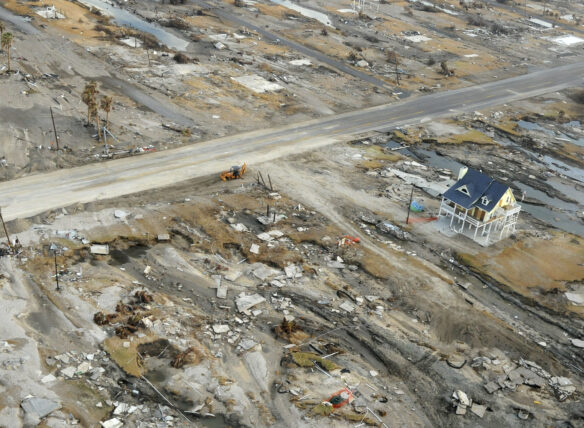
A line of houses, some more than a half-century old, were once positioned safely back from the ocean. Now, roughly four dozen sit with pilings exposed, septic systems visible above the tide, and decks hanging over a void where the beach used to be.
In the last five years, the Atlantic has claimed 12 structures along Hatteras Island — most visibly in Rodanthe but now also in Buxton — and the question has moved from “if” more houses will fall into the ocean to “how many” and “what do we do about it?”
It’s a difficult question because the answers consist of a patchwork of engineering, emergency response, grant programs, local politics, and state law — and the ocean keeps changing the terms.
At a packed public meeting on September 18, government officials, engineers, and residents outlined the options currently being used or considered: federal purchases and grant-funded demolitions, beach nourishment, repairs to existing jetty structures, and voluntary relocation and preemptive demolitions.
But Cape Hatteras National Seashore Superintendent David Hallac summed up the dilemma plainly: “There are no silver bullets… If this were an easy problem to solve, somebody would have solved it a long time ago.”
For Buxton homeowners like Bonnie Clarke Lattimore and Lori Perkins, the issue is far from abstract. Their family homes sit at the edge of the Atlantic — one already lost, one now threatened — and their stories capture the frustration, grief, and urgency behind the policy debates
A house full of memories, lost to the surf
On September 16, Bonnie Clarke Lattimore’s family home collapsed into the ocean.
Built in 1976 by her grandparents, the cottage was small — a one-bedroom bungalow with a spiral staircase — but it was the family’s gathering place for nearly five decades.
“My grandma always wanted a house with a dishwasher. That was her dream house,” Lattimore said. “It wasn’t fancy, but it was ours. We grew up there with cousins and friends, stuffing kids everywhere. The amount of love and memories in that house… it feels like someone died.”
Several years ago, she and the family plotted to move the house inland to another lot they owned, but beach nourishment had briefly stabilized the shoreline, and the plan was delayed.
It was rekindled in August 2025 when waves of erosion once again threatened the home, and Clarke reached back out to her contractor. With pilings exposed and Hurricane Erin brewing, Lattimore knew time was running out.
On August 23, Clarke began contacting county officials to get some guidance on what could be done. Contractors were lined up, and a septic plan was in the works. “I sent emails begging for emergency approval. I told them this is a state of emergency. I had the contractor and surveyor ready. I didn’t want it to fall into the ocean — it’s environmentally and morally wrong to let that happen when we had the means to move it,” she said
But emergency permits were unobtainable. Dare County Planning Director Noah Gillam explained that a complete application is needed first, with a survey, septic evaluation, and other requirements such as an engineered foundation plan, before a permit can be granted.
These are county necessities for moving home from one spot to another, but the requirements also align with other agencies that have input in large-scale home relocation projects, like CAMA or Environmental Health Departments. “There’s not a way to bypass the documents required,” Gillam said. “All of these things have another layer. It would have to be a truly emergency standpoint in order to circumvent all the requirements, and that sort of approval doesn’t exist to my knowledge.”
The morning the house fell, Lattimore’s contractor was standing on site. “Instead of moving my house, I had to pay him to bulldoze it. That was like a dagger to the heart,” she said. “We weren’t trying to get out of the process. We just needed help, quickly. There should be a way for families to save their homes if they have the land and the means…”