Excerpt:
The sea at Tybee Island is rising half an inch a year. Now, the Army Corps of Engineers is trying a new approach to limit erosion…
Barrier islands like Tybee Island, off the coast of Georgia, should naturally accumulate sand from islands farther north, but human activity — development on the island, building sea walls and jetties, creating shipping channels — has disrupted that process. As a result, barrier islands are constantly losing sand, and the beaches are constantly being washed away by the relentless tide.
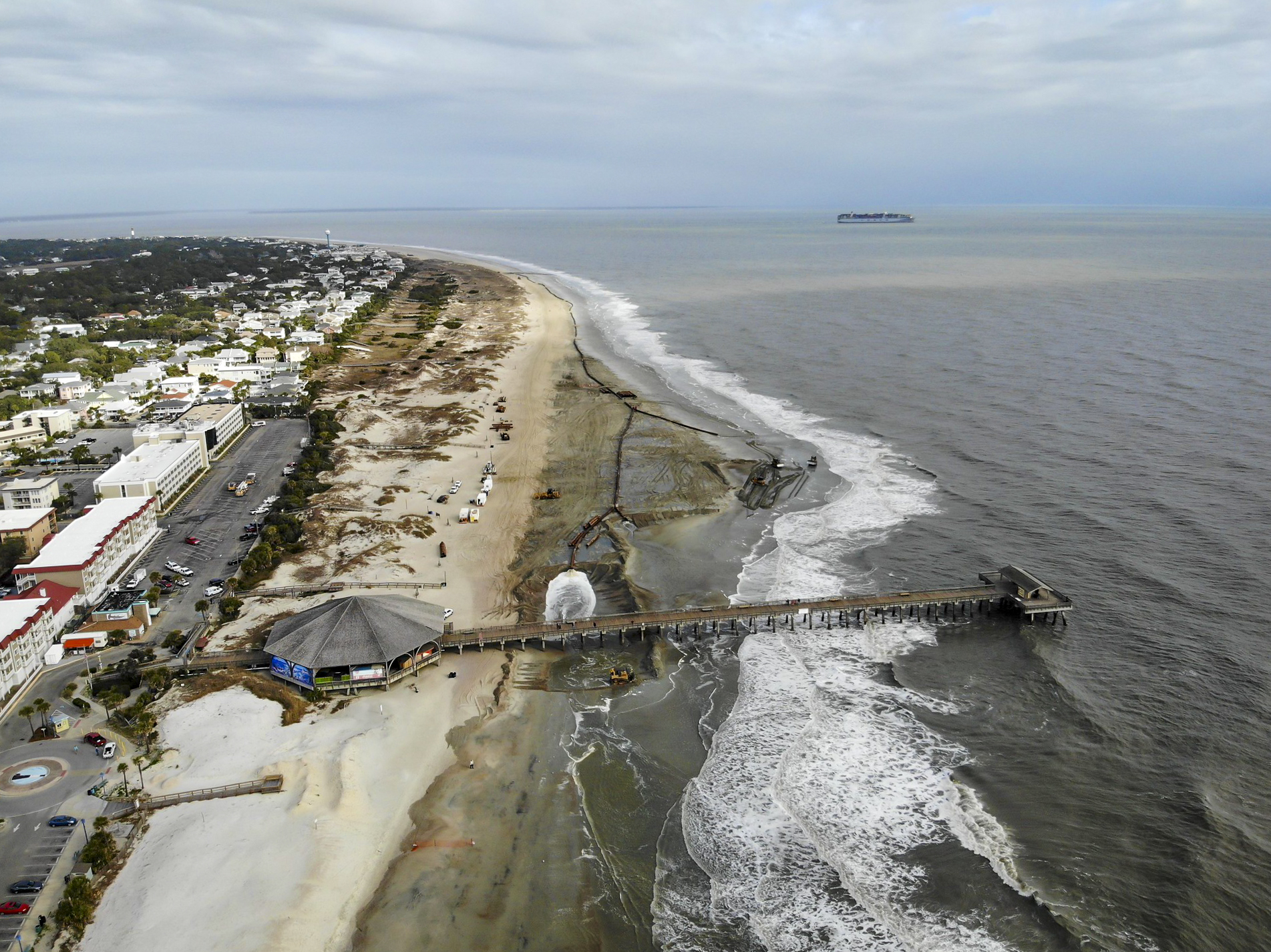
To address the problem, the Army Corps of Engineers has, since the 1970s, been dredging up sand and depositing it onto beaches up and down the east coast. On Tybee, which sits just south of the mouth of the Savannah River, beach renourishment happens every seven years. The natural sand-sharing there is further interrupted by the shipping channel that cuts between Tybee and its neighbors to the north.
In the winter of 2019 and 2020, the Corps placed 1.3 million cubic yards of sand on the Tybee Island beach. More than half of that sand is gone now. On one stretch near the DeSoto Beach Hotel, the dune looks like it’s been chopped in half with a giant knife, ending in a 5-foot cliff instead of a gradual slope.
“It’s extremely stark and startling to see up close and personal,” said city manager Bret Bell. “You can see the vegetation. It’s bisected in half. You can see the roots coming out of the dune system.”
It’s not just the dune grasses. In some places, the tide and storms have cut into sea turtle nests buried in the dune. Businesses are feeling the pinch too. The dramatic erosion has forced chair and umbrella rental operations off the beach in some places, Bell said, and the DeSoto has lost bookings due to the poor state of the beach in front of its doors.
All told, the erosion puts the island itself — and the mainland — at risk. The sea level is rising about half an inch a year due to climate change.
“It is really our only protection against the encroaching oceans,” Bell said. “Storm surge would inundate our island if it weren’t for the mitigating effects of the beach and our dune system”
Tybee Island is due for renourishment again this winter. Planning began when the last renourishment ended, Bell said, and the city, Chatham County, and the state of Georgia have worked since then to set aside enough funds to cover 40 percent of the $20 million price tag — the required local match funding for the federal beach renourishment program. But Congress underfunded that program, according to Bell, and Tybee was left off the project list.
“All of a sudden, all of these beach communities started really competing for the limited amount of funding that there was,” he said…