Excerpt:
As the ferry approaches Tangier, Captain Steven Thomas tells a well-rehearsed history of the island, where crabbing has shaped the culture…
He points out a handful of tiny buildings on stilts in the water.
“Those are all crab shanties,” he says over the boat’s loudspeaker. “That’s where they shed the softshell crabs during the summer months.”
Tangier Island — off the mainland coast of Virginia — is one of the last inhabited islands in the Chesapeake Bay. Before colonial settlers arrived in the 1700s, Indigenous people likely traveled to the island in the summer to take advantage of the abundant fish and crabs, according to the National Park Service. Many descendants of the original settlers — with surnames like Crockett, Parks and Thomas — have remained to this day. The isolation has allowed the development of a unique accent, one that some residents describe as a mix between “Southern” and “Elizabethan” English.
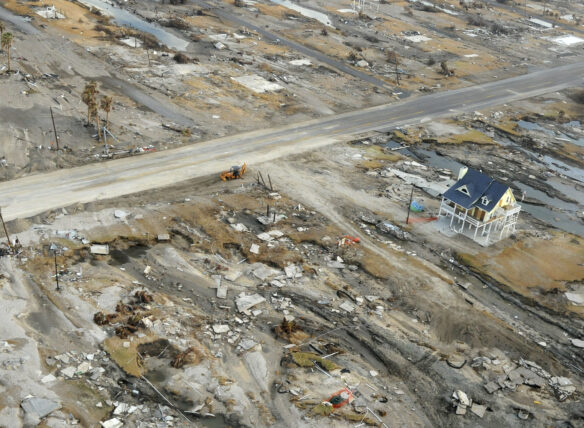
Since 1850, the island has lost two-thirds of its landmass to erosion and sea level rise. On average, the island sits just three feet above sea level. Meanwhile, water levels in the Bay are rising by at least a quarter of an inch each year.
The island could be almost entirely underwater in the next 50 years, according to experts like Dave Schulte, a climate change researcher and ecological restoration specialist who studied Tangier extensively. Schulte co-wrote defining reports on the island in 2015 and 2021 and formerly worked for the U.S. Army Corps of Engineers.
“Our predictions indicated that the island will need to be abandoned in roughly 25-30 years,” Schulte told NPR.
Climate change is worsening the erosion of the island, contributing to both higher sea levels and more damaging storms.
“Erosion has always been an issue for all Chesapeake Bay islands, but sea level rise is accelerating the rate at which it’s occurring. Then, you’ve got storms, which have always been an issue,” Schulte said. “But again, due to climate change, they are becoming more frequent and intense, causing more damage.”
On top of all this, the entire Chesapeake Bay region is “subsiding tectonically,” according to Schulte.
In other words, it’s sinking…