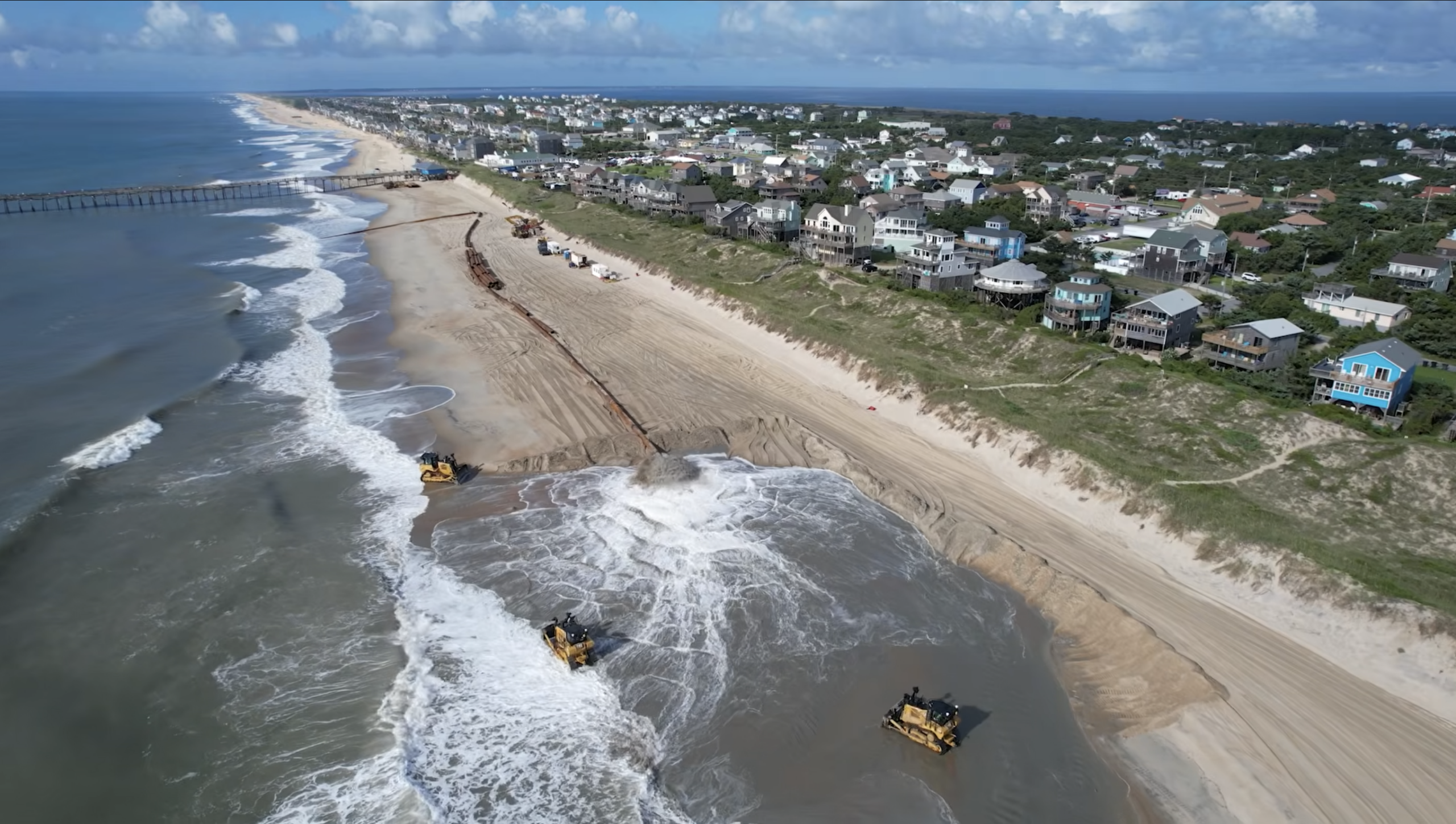
Excerpt:
For years, Dare County has relied on a relatively predictable formula to manage its changing oceanfront: invest local tourism dollars into shoreline protection efforts, and depend on federal support to help sustain those projects and recover from storms.
In 2026, that formula is showing signs of strain.
At the center of the uncertainty for upcoming beach nourishment projects is the Federal Emergency Management Agency — better known as FEMA — where policy changes, funding delays, and broader federal debates about disaster response are creating unknowns for coastal communities nationwide, including those on the Outer Banks.
Local officials say the biggest issue is not whether FEMA funding exists, but whether it will arrive in time — or in the same form as it has in the past.
A quick background on Dare County’s beach nourishment funding model
Dare County’s beach nourishment efforts are primarily funded through a locally controlled revenue stream: two percent of the county’s six percent occupancy tax, which is paid by visitors staying in vacation rentals, hotels, and other accommodations, coupled with smaller amounts provided by specially created tax districts. (On Hatteras Island, those tax districts include Avon and a portion of Buxton.)
That funding source has allowed the county to invest heavily in shoreline management. According to Dare County Board of Commissioners Chairman Bob Woodard, the county will have spent more than $300 million on nourishment projects once the next Buxton project is complete in 2026.
But local dollars are only part of the equation.
Once a beach has been “engineered” through nourishment, it becomes eligible for FEMA’s Public Assistance funding following storm-related erosion. That federal program, which typically covers a significant share of disaster recovery costs, is critical to maintaining projects over time.
Under FEMA’s Public Assistance framework, the federal government generally reimburses a large share of eligible disaster recovery costs, including infrastructure and shoreline repairs.
That reimbursement model has historically made large-scale nourishment financially viable, or at the very least, has allowed Dare County to pursue larger beach nourishment projects that are likely to last a bit longer.
For example, the importance of FEMA funding was evident during Buxton’s 2022 maintenance beach nourishment project. According to prior reporting, the agency reimbursed $4,337,149 for the placement of 303,732 cubic yards of sand along nearly three miles of beach.
That federal contribution certainly did not fund the entire project, but it significantly reduced the local financial burden and reinforced a model where local investment is paired with federal recovery support.
Without that partnership, maintaining engineered beaches naturally becomes more difficult.
In January 2025, Dare County submitted a request for FEMA funding tied to storm-related erosion, a routine step following past nourishment cycles.
More than a year later, county officials are still waiting for a definitive response.
“We have not heard back from FEMA, which is making us a little nervous,” Woodard said during his March 2026 State of the County presentation.
The lack of clarity is already influencing local planning.
According to Assistant Dare County Manager Dustin Peele, FEMA reimbursement could determine the overall size and timeline of the upcoming Avon and Buxton nourishment projects.
If funding is approved, the county can place a larger volume of sand along both shorelines. If not, the projects will still move forward, but with a smaller footprint.
If the worst-case scenario occurs and no FEMA funds arrive in time for the summer of 2026 nourishment projects, it’s not the end of the cycle, or the end of the world.
Instead, the next maintenance nourishment projects, which are typically scheduled every five years, may be pushed up to two or three years from now, depending on how 2026’s projects fare…